Author Archives: Pataki Veronika

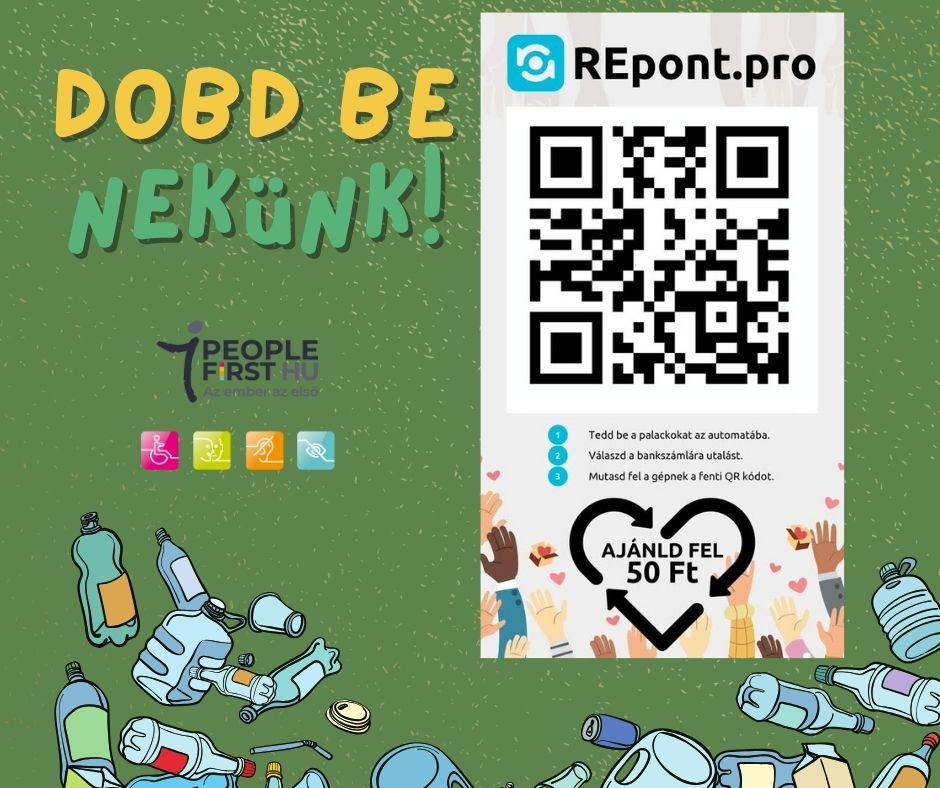
Throw it in for us!

Did you know that now you can support us with your returned bottles too?
Simply scan the QR code of People First Public Benefit Association at the Repont machine, and the deposit refund will go directly to us.
Small bottle, big change.

Important: on the machine’s display, do not choose “charity” but “bank transfer” – only this way will your contribution reach our association.

What do you support when you throw it in for us?

At People First Association we believe: everyone counts.
Through our awareness-raising work and our efforts to make Pécs and its surroundings accessible, we are building inclusivity and community cohesion – so that every resident of Pécs feels they have a place in society.

Let’s make Pécs belong to everyone!
Help us ensure that Pécs is not only inclusive on the map, but in reality too!

With your support, you help us in our work to promote independent living and self-determination for people with disabilities, as well as to make the built environment and tourism accessible. In addition, we explore accessible locations in our surroundings and continuously update them in our Barrier-freePécs Database (https://peoplefirst.hu/helyszinek), which is freely available to everyone in both Hungarian and English.

How can you help us?

If you value our work and are able to support us, it would mean a huge help to us!

Our association treasures its independence, because we believe that only in this way can we truly listen to the voices of the community. With no outside commitments to distract us, we can hear the real problems and respond to them.

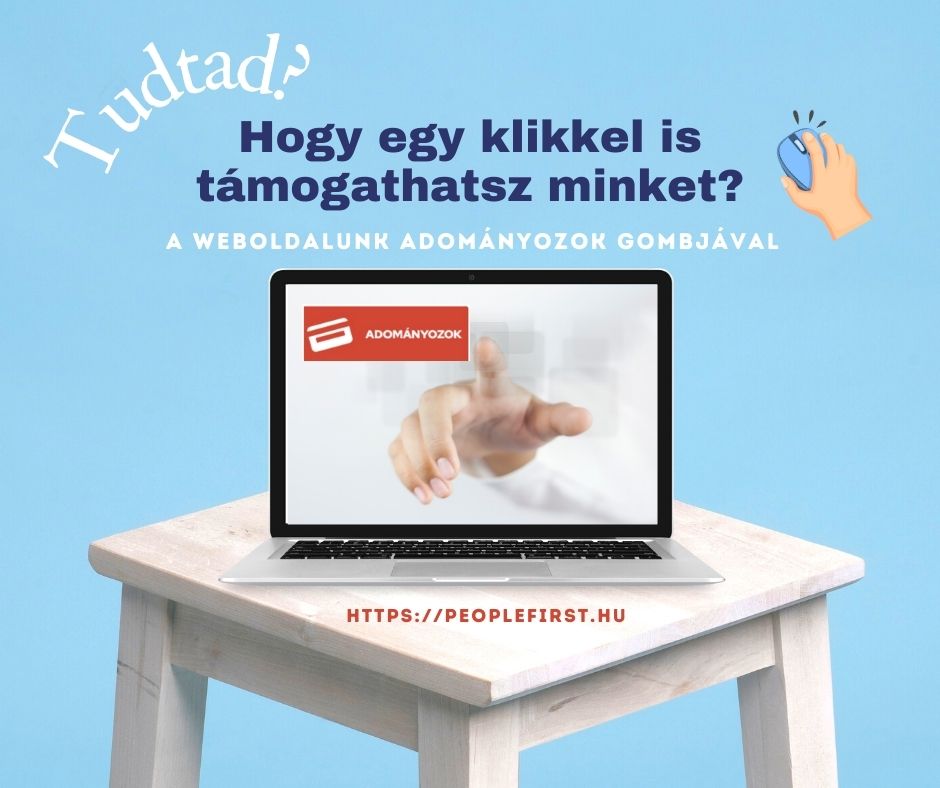
To support us, you can simply use the red ADOMÁNYOZOK / DONATE button on the right side of our website. With just one click you can choose the amount you’d like to give. You can decide whether to make a one-time donation or bring us even greater joy by becoming our regular supporter.

If you prefer traditional bank transfer, you can send your contribution here:
MagNet Bank 16200010-10142350

Thank you so much for your support! 🙂

Captions for the image in English:
Did you know? That you can support us with just one click? With the ADOMÁNYOZOK / DONATE button on our website: https://peoplefirst.hu

WHY campaign 18: WHY are Inclusion and Integration different?

Let’s start with the People First Association’s credo:
In an inclusive society, there is no definition of “normal” that all members of society must strive for and achieve. The only thing that is normal is the fact that there are differences. These differences are seen as enriching society and do not affect individuals’ fundamental right to participate. Societiy has a responsibility to create structures in all areas of life that allow its members to move freely within it.

The above statement essentially sums up what we mean by an inclusive society. However, in most European societies, this is not a widely recognized expectation among members of society. Many people do not understand or agree with why everyone should be the same when they are not. But that is not what this is about, just read on…

Let’s start with the term inclusion.
Even understanding the word itself may cause problems. In some countries, inclusion is a clear term, but in others it is not. A good example of this is Hungary, where inclusion is a term that exists but is not widely used in society. Instead, people use descriptive words such as social acceptance, social inclusion, diverse society…
This is definitely an avoidance of clearly stating something and calling it by its name. The reason for this is that the acceptance of “otherness” is still a relatively new social phenomenon, so many people are afraid of it.

Since integration also aims at unified social acceptance, many people confuse it with inclusion.
So what is the difference between integration and inclusion?

These two terms are often difficult to distinguish, so let’s compare them side by side.

The most noticeable difference between inclusion and integration is that while integration only means acceptance in numerical terms (for example, the presence of a disabled child among non-disabled children in a kindergarten group), inclusion is also reflected in the group’s common attitude and the inner feelings of individuals.

Integration tends to focus on unification and assimilation, and is most noticeable in education.
Meanwhile, the inclusive approach ensures equal access to opportunities and resources for everyone.

With inclusion, the emphasis is on interaction. It means ensuring that disadvantaged individuals participate in social processes. In other words, inclusion is not just about being together, but also about shared activities (e.g., playing, learning, working together). This requires adaptation on the part of both the person who is including someone and the person who is being included in a group.

Here we are actually talking about a process. Inclusion means a higher level of integration.

A term or an attitude?
The basic prerequisite for inclusion is knowledge about certain groups of people.
But! We must distinguish between knowledge and assumptions, i.e., what people believe about people with disabilities and what they know about them.

Successful inclusion is primarily a question of attitude.
This requires social sensitivity, empathy, acceptance of differences, and the ability to manage differences. It is important that these skills can be developed! The primary place for this should be kindergarten and school.

Written by Veronika Pataki

Organising the 2025 Barrierfree Tourismus Day festival has started

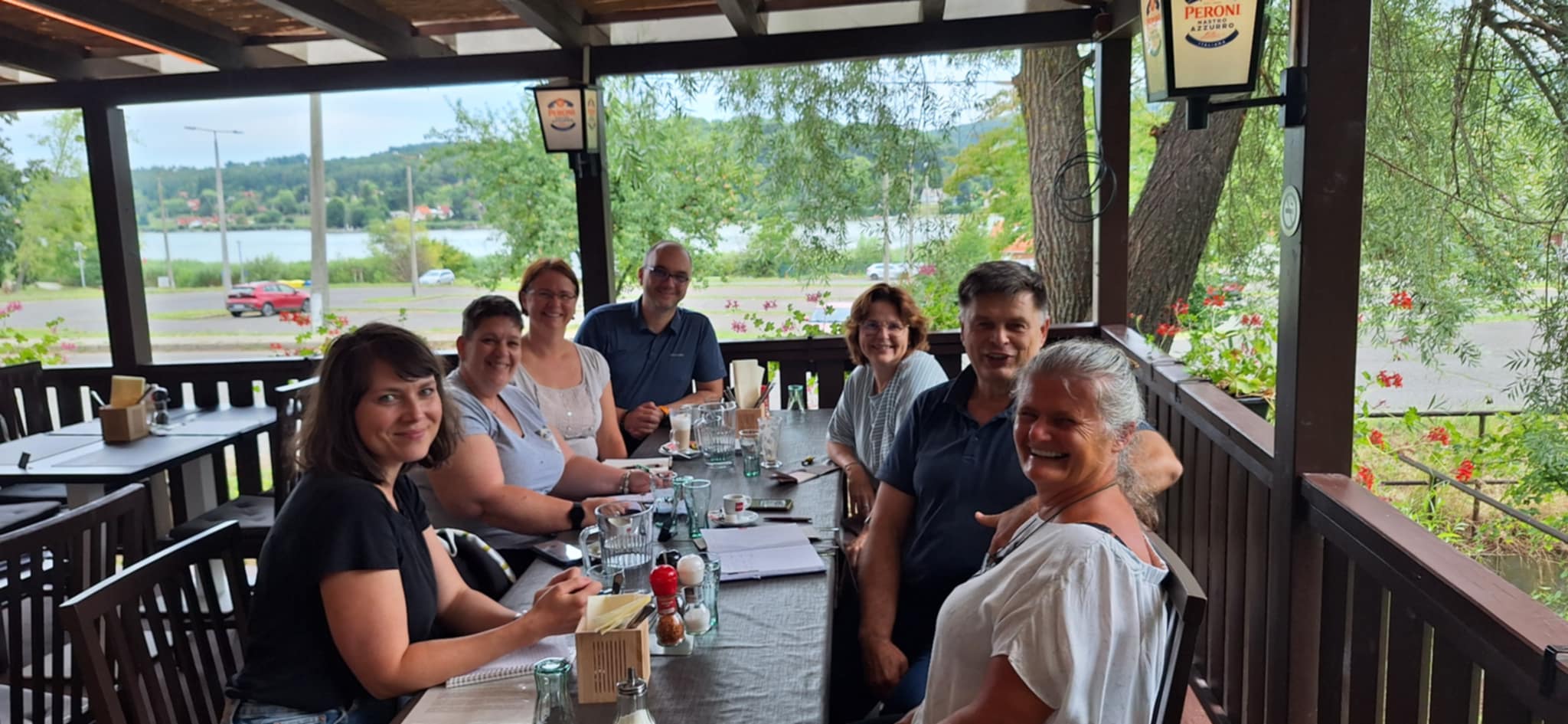
The organising committee met on 16 July 2025 in a really nice place, the Chill Terrace Brunch Restaurant & Bar in Orfű, and we discussed the remaining tasks.

As you know, this year on SEPTEMBER 6, SATURDAY, we will meet on the IX Accessible Tourism Day in Orfű. Our hard-working people have been busy preparing the event, so we are sure you will have a great time again this year at the country’s greatest inclusive festival, disabled and able-bodied together!

So what can you expect?
This year again at 10.00 we will OPEN the imaginary GATES.
But LOVE BUFFET will be waiting for those who started the day without breakfast from 9.00 am.
At 9.00 a.m., we will also be waiting for our VOLUNTEERS for the usual final, personal briefing. If you have not yet signed up, please do so, we welcome volunteer helping hands. You can email us here: akadalymentes.turizmus.nap@gmail.com
We also welcome high school students, we can certify 50 hours of IKSZ.
We will be serving LUNCH from noon, again this year we have a wide variety of food available.
The event will CLOSE at 16.00.

EXPERIENCE PROGRAMMES will again this year provide a great day out for everyone. As a person with a disability, we hope you can have an experience you might not usually have. Or if you’ve been before, you can experience it again.
– there will be motorbike rides (with lots of motorbikes, including some specially adapted for people with disabilities)
– horse riding and carriage rides
– dragon boat rides
– sailing and speedboat
– fishing
– gokarting
– driving, especially for the visually impaired
– rally driving
– WR adventure with glasses
and….even an oldtimer will drop by.

Of course, we also take care of everything else to make you feel as comfortable as possible.

🚾There will be toilets near all the attractions, and accessible toilets in several places. You will be able to see them on a map.
♿️ Walkway elements will be placed on the island so you can roll around.
🚐Three minibuses will run between the sites, two of them with ramps, barrier-free.
ℹ️ Info tent will be waiting for you at the usual place at the entrance, next to the Sports Camp on the way to the island with useful information.
🅿️ Parking will also be arranged and a map will be provided.

A problem every year is that the summer season is just ending and there are hardly any buses between Pécs and Orfű. This year we will try again to solve this problem. We have already promised by official letter that the Volán will increase the frequency of services during the festival, at least around the opening and closing times. We are hoping for accessible buses, as requested.

Detailed information will of course be provided as the organisation progresses. Follow us on the event Facebook page for updates: https://www.facebook.com/turizmus.akadalymentes

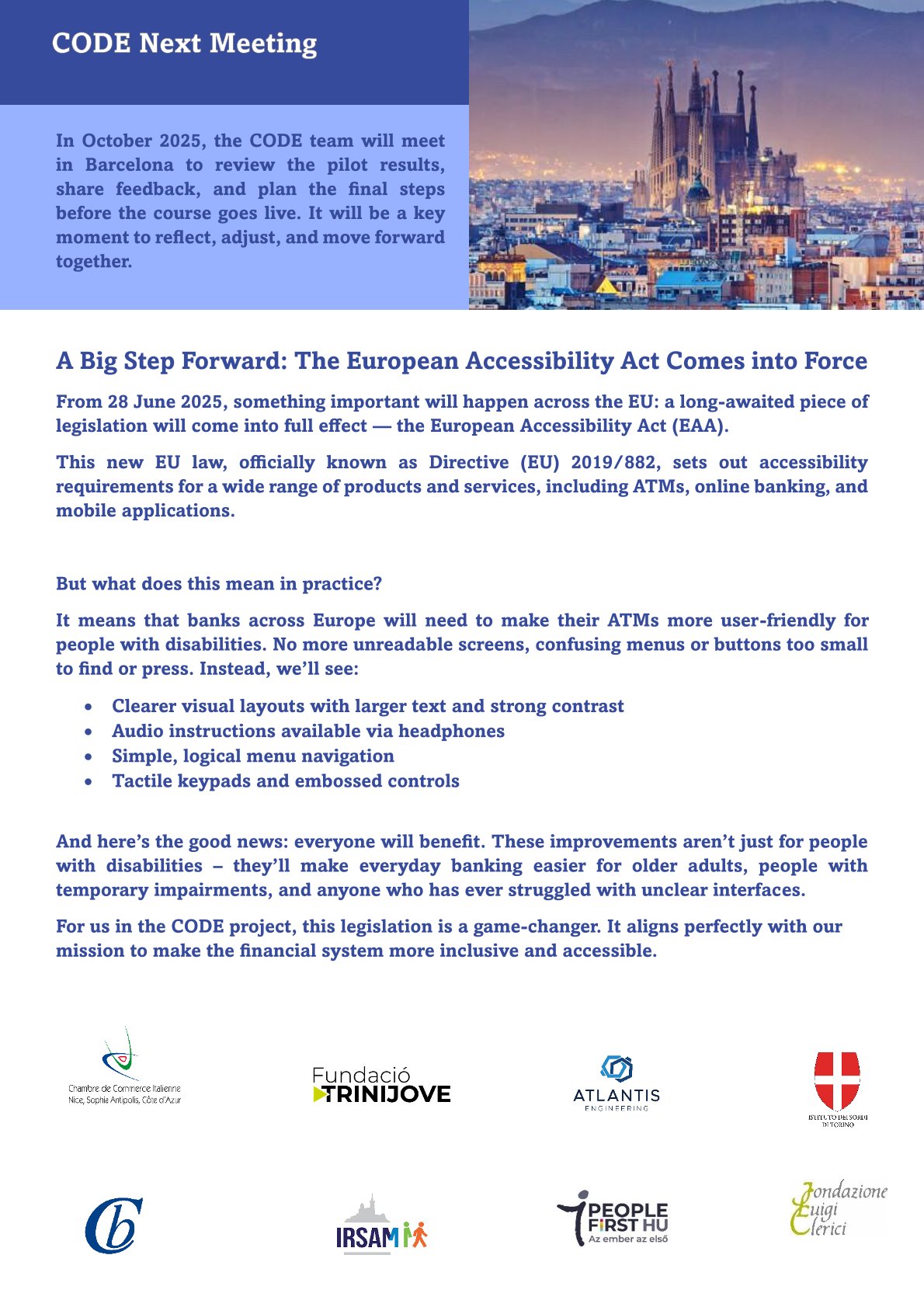
CODE news: excellent training material created!

We have great news in our international CODE project, which works to make the financial sector and banking accessible!

We have completed a comprehensive training material consisting of five modules that cover everything related to financial services and banking. We worked with numerous experts and sought the opinions of those directly affected—people with disabilities—so we believe we have developed truly valuable educational material. We considered it very important to make this course accessible in every way, so we translated it into the languages of all partner countries and made it available in a variety of formats, from Word documents to PDFs and videos, with visual elements and audio descriptions to help with reading and comprehension.

Now comes the pilot phase, where we will test the curriculum with groups of people with disabilities and finalize the training based on their valuable feedback.

Another big news is that on June 28, 2025, an EU regulation of fundamental importance to our project came into force! The European Accessibility Directive, officially known as Directive (EU) 2019/882, more commonly referred to as the European Accessibility Act (EAA), aims to ensure that uniform rules apply to the accessibility of digital products and services, including online banking services and ATMs, in the EU market.

From the end of June, all banks must adapt their ATMs to the new EU accessibility directive. The aim is to remove the barriers that currently make it difficult for people with disabilities to use ATMs.
The legislation requires developers to design and construct ATMs that are accessible to people with visual, hearing, intellectual, or other disabilities. The most important changes to ATMs include larger font sizes and better contrast on the display, voice instructions through headphones, clearer, more intuitive menus, tactile surfaces, and embossed buttons.
Like all accessibility initiatives, these changes will not only make it easier for people with disabilities to carry out administrative tasks. All users will benefit from clearer displays, easier-to-understand menus, and more precise instructions.
Banks must inform their customers about the changes.
This directive was adopted by the EU in 2019, but member states are only required to apply it from June 28, 2025.

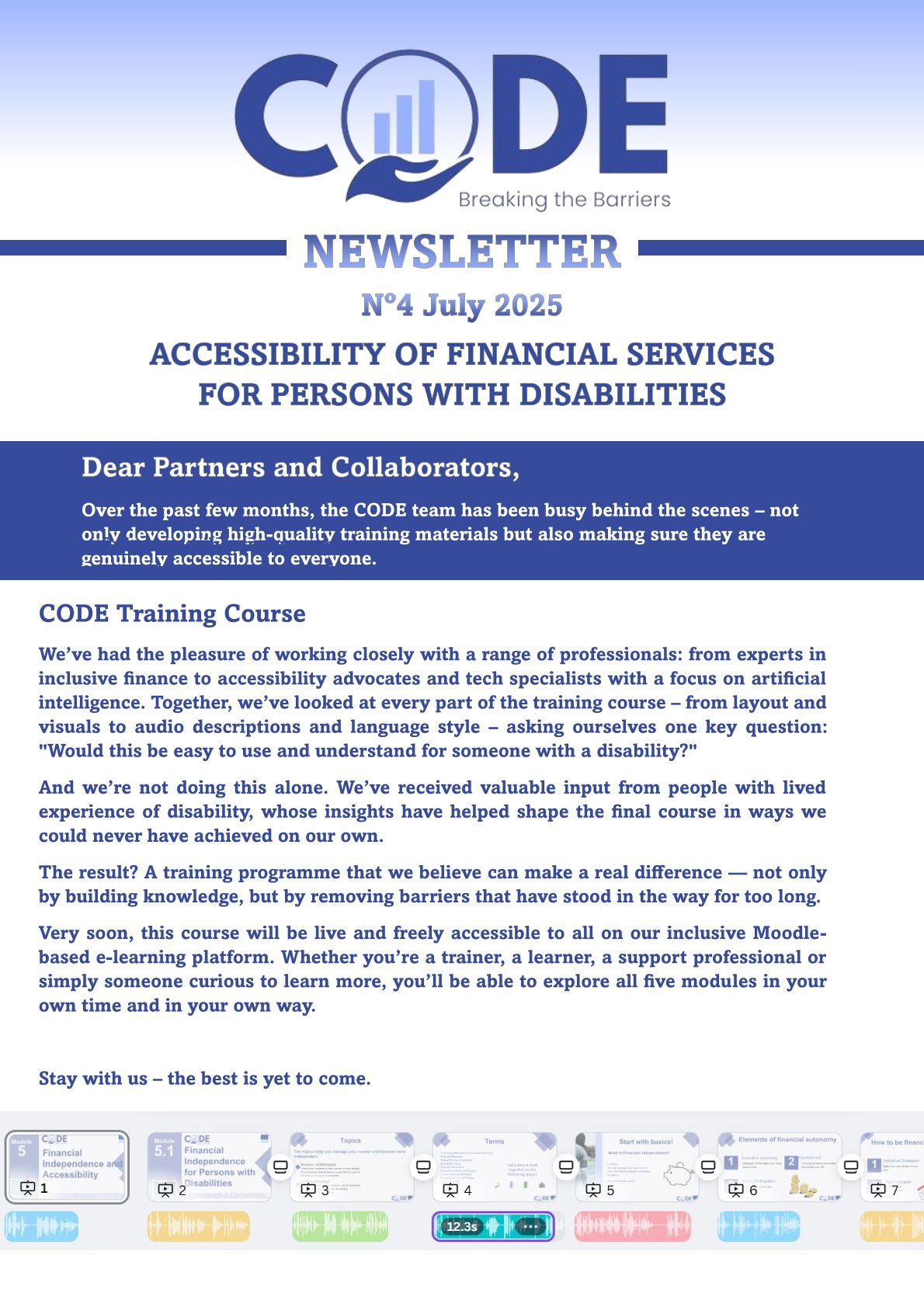
Please read our latest information in the current newsletter of our CODE project. Share it with others, people with disabilities, interested parties, training centers, and the banking sector!
Follow us on the People First Facebook page or the CODE project  Facebook page for updates on the project’s progress.
The July 2025 newsletter of the CODE project is available in PDF format by clicking here: EN_CODE_Newsletter4_July 2025 (1)

WHY campaign 17: WHY do you also need a barrier-free toilet?

Where the king can only sometimes enter through barriers

(In fact, in Hungarian we even jokingly refer to the toilet as ‘the place even the king goes to on foot.)

A handicapped WC, a wheelchair accessible toilet, and sometimes – increasingly – a barrier-free toilet. This is what the signs say. How does a disabled toilet become a disabled, how should this be imagined? – my autistic mind jokes with me every time I see or hear this term, and it already lists the most absurd images, ticking off the generative artificial intelligences.
Actually, the correct name for these rooms is accessible toilets. In fact, there are places in the world where they are called available, emergency toilets.
Here in Hungary, this is usually where the changing room is located, and the same room is often offered for breastfeeding, as a baby-mother room.

Its inappropriate alternative uses: warehouse, small office, staff lounge, changing room… I’m doubly angry about these. Why double?
Who wants to store their belongings, have lunch, coffee and administration in a toilet when they have other options?
And likewise: who wants to go to the toilet in an office/changing room/dining room, after a long wait to unload the obstructing swivel chair, cardboard boxes, cleaning equipment, huge cleaning machine, anything else that could be an accident hazard…?
Even so, such grotesque situations occur countless times!

But even if everything is fine inside, there may be other obstacles to entry. These toilets are usually locked with a key, which means that you can’t just walk in, but have to call for outside help, either by ringing a bell, or by phone, or in person. The keeper of the keys is either available or not. Either he comes quickly, or you have to wait a long time, or he doesn’t come at all, and then you’re in big trouble.
If the person in charge turns up early, there is still the unpleasant possibility that the person is not properly informed and will act as a kind of inspector, deciding whether or not you are entitled to use the toilet, whether or not your personal assistant or guide dog can enter with you.

I have had unpleasant moments, even when using a support stick. The most interesting was when the staff member offered to open the accessible toilet for me, as all the others were in use – if I’m not ashamed, I don’t mind “it”. I joked about it, but I really wondered: would it be shameful, embarrassing to use the toilet in dignified, safe conditions? No, but too often it involves unpleasant interludes, awkward moments.
Sometimes, unfortunately, with explicit violations of rights: recently, my fellow members have suffered serious violations because of a lack of information, an inappropriate attitude.

Interesting fact:
Several organisations around the world offer keys, sometimes literally. The user has to prove his status to the company and, after paying an annual membership fee, he receives a special key that can be used to open all the toilets in the network, even in several countries. No need to look for money or cards, no need to wait for a man with a key, no need to be afraid of unpleasant situations or people.
In Paris and Japan, for example, anyone can use the barrier-free toilets, they are not locked and they are free of charge.
These solutions are not yet available in Hungary.

Fortunately, it’s not all dark and terrible, but it’s a major deterrent for me and an almost constant source of anxiety for those who can’t go to a ‘traditional’ toilet.
Even among my disabled acquaintances there are those who have a healthy point of view: if you don’t seem to have a problem, you have no business being there, shame on you! I mean: they would send me away too, who could use a strong reason for several reasons. And I’m already thinking: if I’m well, I won’t use it unless I really have to. I’ve internalised this nicely too – that is, it’s become part of my thinking, part of my behaviour – so that I feel guilty for not looking disabled or just being better than usual.

So then, who’s actually allowed to use the accessible toilet?

In an ideal society, a barrier-free toilet is available to anyone who feels that they can do their business safely in a specially designed room.

This means that, in addition to people with mobility impairments, for example, people who seem to be great at moving, but when it comes to sitting down or standing up, turning around in tight spaces, making movements – they are less able for whatever reason.

Or the visually impaired: these rooms have a roughly uniform interior design, making it easier to find what’s where and not hurting users when navigating. If you have a guide dog or other assistance dog, they can fit in here too. (Yes, they can go in, and should go in with the owner. These specially trained dogs are not muzzled, but wear a special harness.)

It can also be useful for pregnant women.

These rooms should have a larger bin, especially as they are usually also changing rooms. People with a stoma can empty and change the bag more easily here. The catheter can be emptied more conveniently and hygienically.
The larger bin also fits used adult incontinence products.

Is there somewhere to inject the insulin or other injectable medication? Yes, there should be a room for this in the accessible toilet. (However, they do not have a hazardous waste container, so the user has to take the needle etc. with them and put it in a suitable place in a suitable container.)

You could use it if you have a problem that you can’t wait for the occasional long line, such as IBD, Crohn’s, urge incontinence, or if you “just” had a problem with your sandwich.

Accessible toilets would also be a good idea, if:

You’re sensory over-sensitive, so you can’t stand the constant door slamming, the hand dryer screaming… or you have some other condition that makes using the communal toilet a nightmare instead of a relief.

You are likely to be unwell or require assistance: this toilet has an alarm. (Difficulties: the alarm does not work or the staff do not know what the beep is, where it is coming from and what to do.)

You have an immune condition that makes it not good to be around too many people: these toilets are less used and they are usually more careful to clean. And in case of a problem, you can disinfect it yourself more easily.

Traditional small, narrow cabins are not big enough, you can’t move freely in them (whether because of your size, you have a mobility problem or you don’t like the “walls” touching you)

You have a temporary condition that requires: using two crutches or braces, an injury that is invisible to others and prevents you from moving (even a surgical scar that is healing, a broken rib), or a balance problem…

If you are with a baby or pushchair and there is no dedicated toilet available.

Last but not least, one very important thing: if you need a personal assistant!
It doesn’t matter what your mobility status is, what your relationship is with the person, or what gender they are. Nor is it an argument that “but they didn’t need a helper before”. There are ups and downs: one day you help, the next day you get help. In order for a personal helper to help you, they have to be there with you, inside. Neither one of you has to justify the other’s presence or intention to enter.

To top it off, the really super rooms have adult-sized (fold-down) surfaces for changing nappies and even showers and hazardous waste bins. And in the ultra-supers, there’s a patient-moving lift.

Because of what I and my fellow members of the People First Association have experienced, I have only one place in the whole country where I regularly and willingly use the accessible toilets. This place is the I Love Pécs Café in Pécs, where I often go for a good chat, a refreshing or warming drink, and I have even had the opportunity to have an online conference call here. Here you know what’s for who, no awkward communication, no weird looks, no cleaning things to get around and it’s only closed when it’s busy. Then I can wait in comfort.

Anyway, if there is no stroller space or a properly designed cubicle, I hurt myself, the stimuli make me feel terrible – in fact, I often start by cleaning, but that’s a user-side problem. And I even pay for it.

I’d be much happier if I could expand my “feel-free to come here” list! I hope that with this writing we are getting closer to that goal.

❗️Let us know your experiences with accessible toilets in a comment!

Written by Hilda Kerekes


Self-determination in long-term care – FairCare

The second personal meeting of our FairCare project was held in Dun Laoghaire, near Dublin, on 25-26 June 2025. During the two-day meeting, important issues were taken forward by the Erasmus+ project on developing self-determined lives in long-term care.

We reviewed the evaluation of the questionnaires on the needs of the three target groups (people with disabilities, family members/carers and institutional staff), which formed the basis of the project. This is very important because these needs will now be used as a basis for the development of the training material aimed at empowering people in need of care to develop self-determination.

Following the discussion of the training topics, the design of an interactive platform was the topic, which will be used for the training material and communication between the target groups. This will be created by People First.

The dissemination of project ideas, news and progress, as well as the internal communication of the project team, is essential to work effectively and achieve the best possible results. The latter can be a challenge for an international team, so we had to talk about it, also as a task for our association.

We left the pleasantly cool, beautiful seaside town with good feelings, because the FairCare project is going very well. We feel that the principle of “Nothing about us without us”, i.e. the active involvement of target groups, continues to be excellently implemented.

You can read more about our FairCare project here in our website’s Projects menu: FairCare project

General Meeting

The Association held its Annual General Meeting on 5. June 2025 at the House of Civil Communities in Pécs.
The General Meeting was well represented by the members of the association, so it was quorate.

The membership first had to face the dry facts and listened to the 2024 financial report of the Presidency, which was accepted.
The 2024 progress report was much more stimulating, there were questions of interest and clarification, and the progress report was also approved by the assembly. There was much to report to the Presidency, once again 2024 was a very busy year.

We then moved on to freer topics and presented the certificates of appreciation to our most active members in 2024. Ildikó Kakusziné Tamasy and Gyöngyi Molnár received certificates for their work last year. With this we would like to make it memorable to all of us how much we appreciate and thank both of them for their commitment and heartfelt activities for the disabled society and the association’s causes. Thank you!
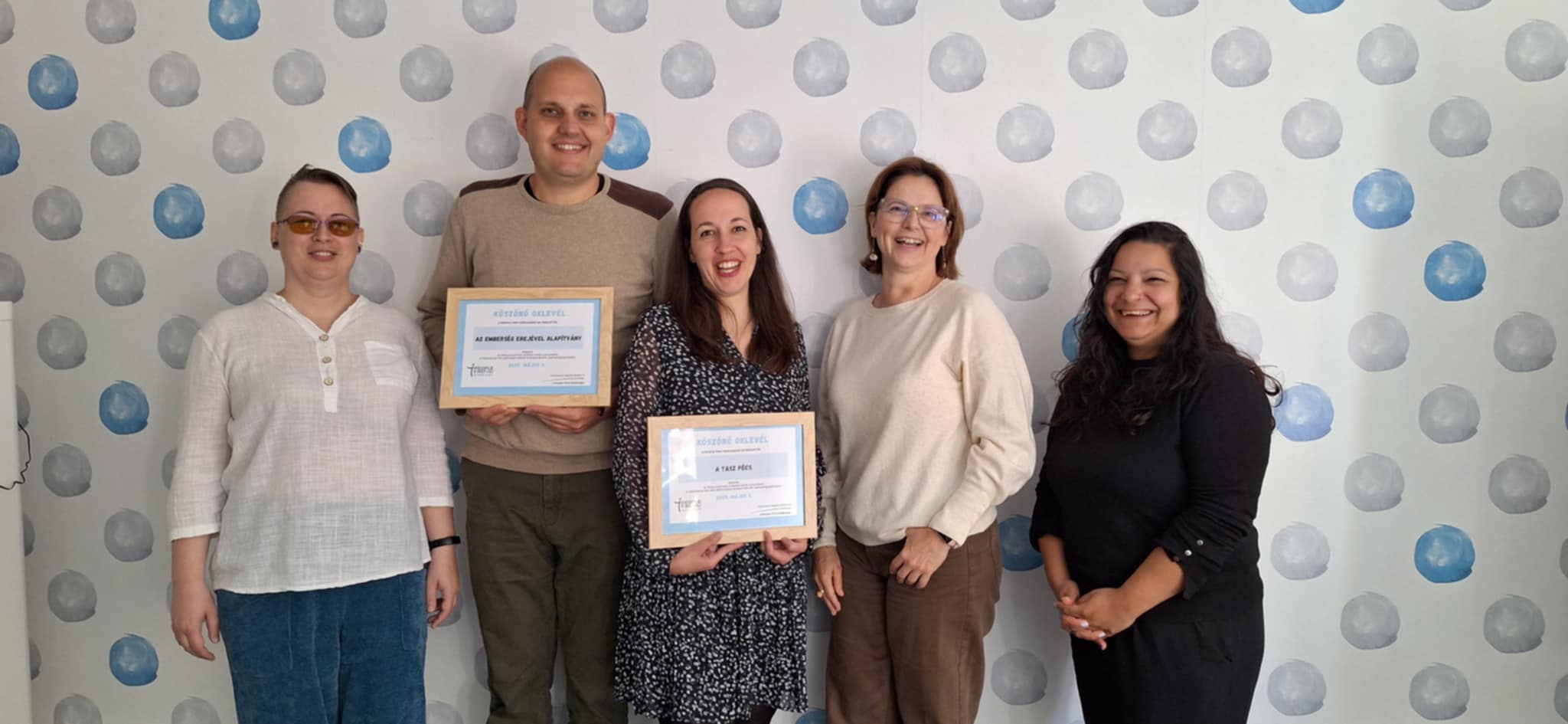
This year our partner organisations Emberség Erejével Alapítvány and TASZ Pécs received a certificate from us. Both organisations are doing a lot for the development of human rights of the local disabled community, and we owe a lot to them in partnership building. Our partners received the certificate earlier, on the European Independent Living Day on 5 May.

Even targeting the buffet table, we have started to talk about the organisational changes that the increasingly complex functioning of the association requires. The General Assembly approved the change plan, and its implementation will start shortly for a test period.

Then, in order to strengthen the internal life of the association, this year’s leisure and cultural plans were discussed. This included the planning of excursions, community-building team games and open programmes.

In the questions and answers session we had a lively discussion, including useful information, excellent new ideas and training for the membership.

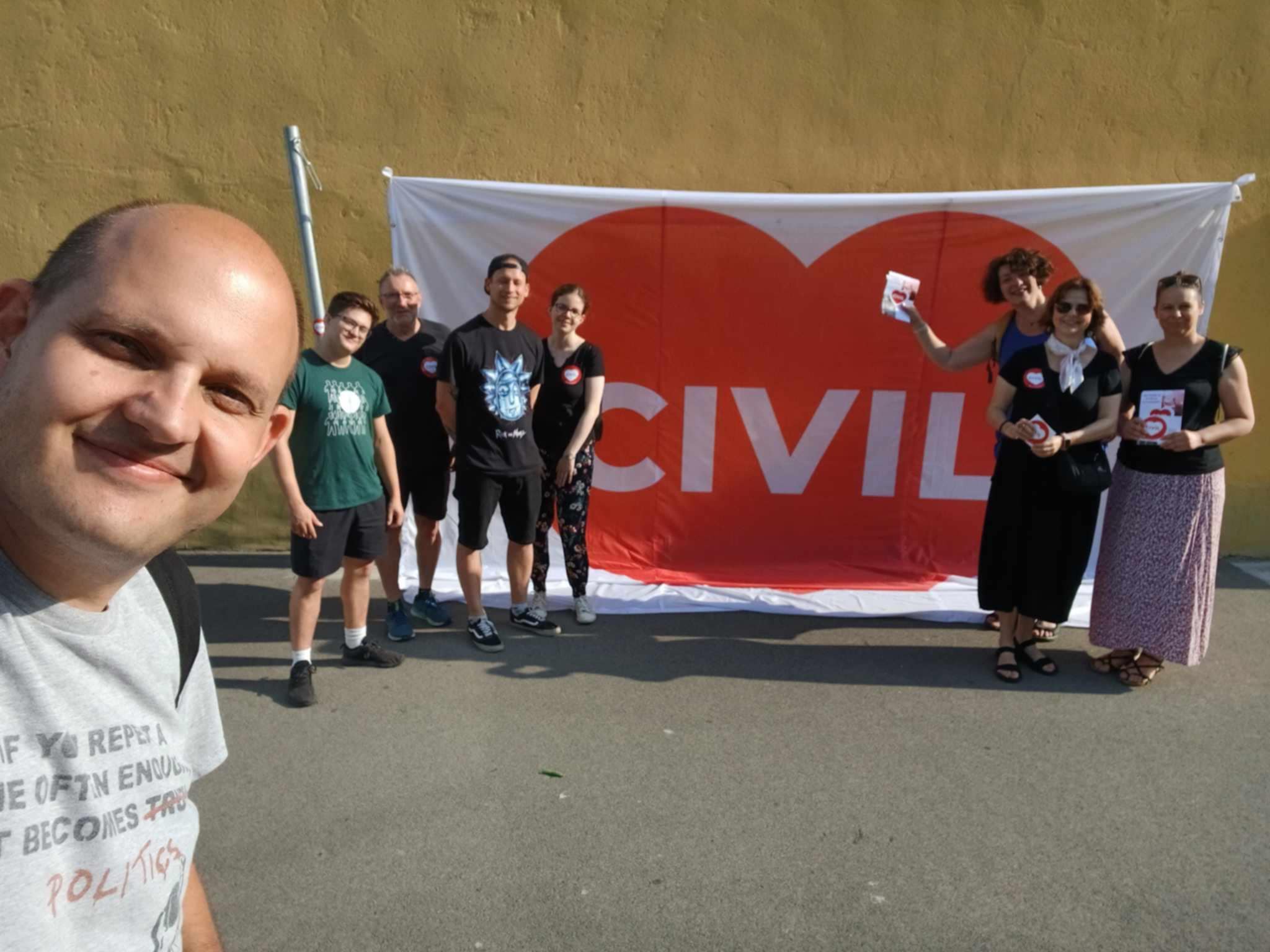
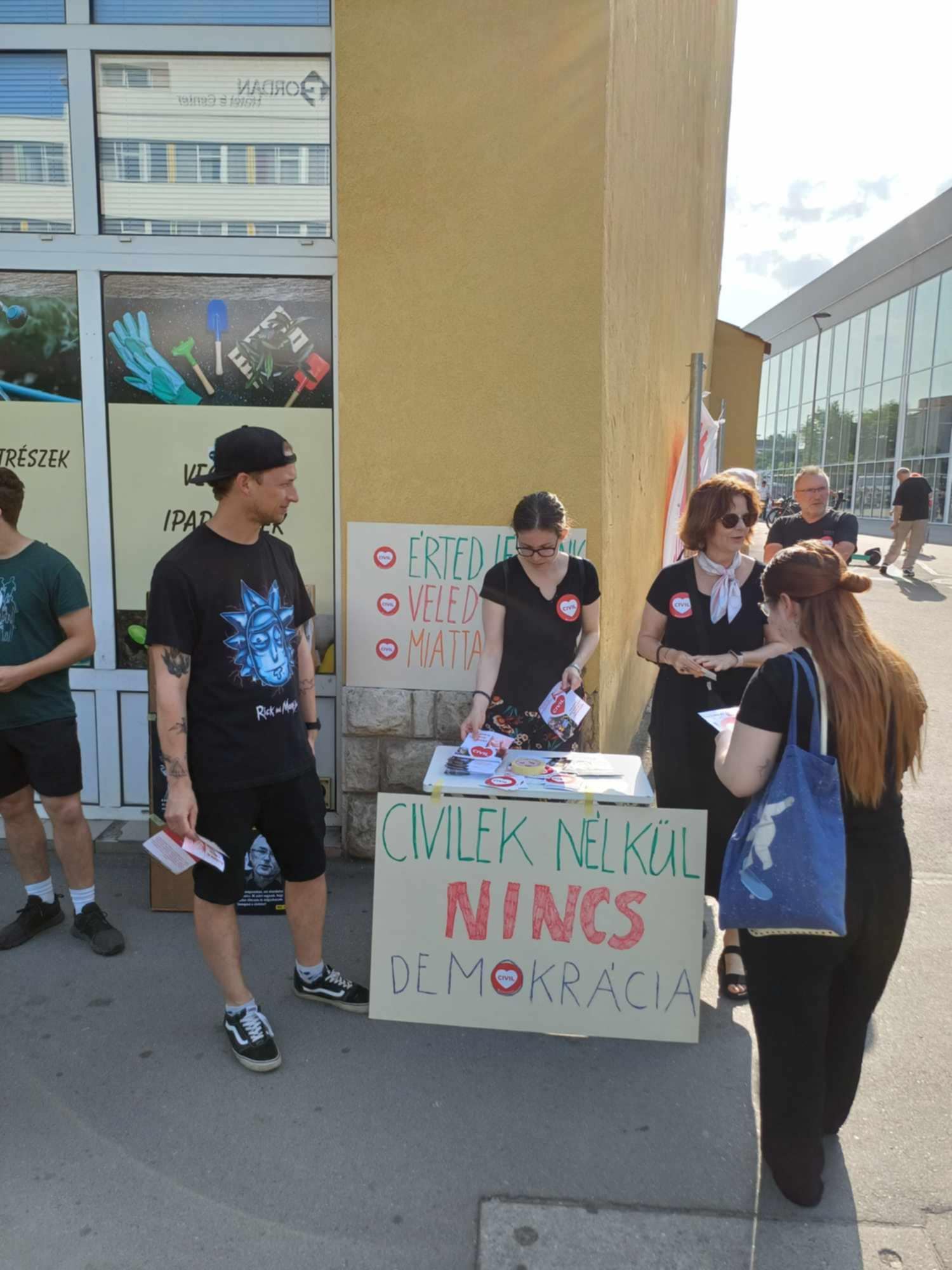
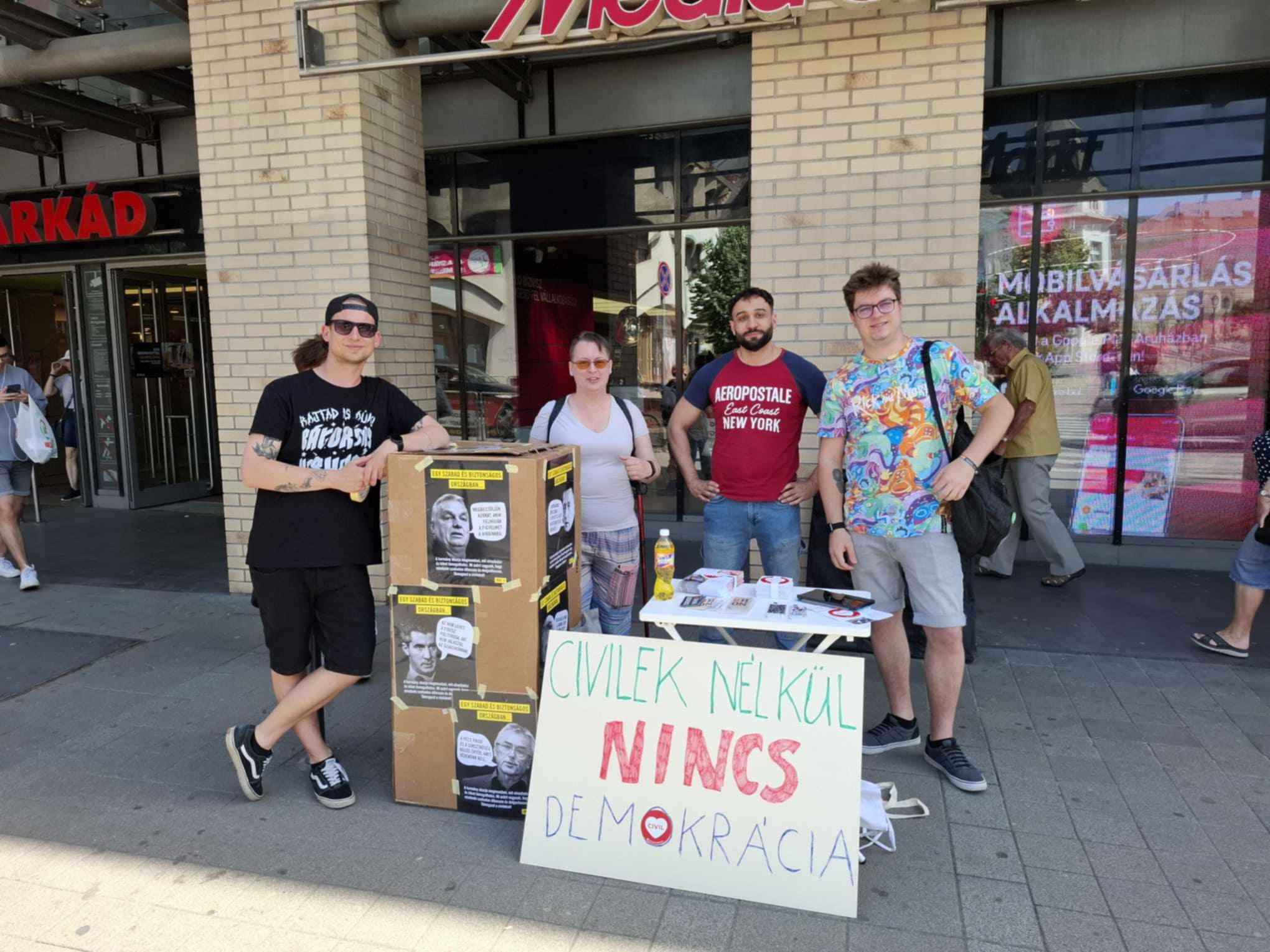
We went to the streets for civilians!

We have won the battle, but not yet the war.

In recent weeks, the government’s proposal for a “Law on the Protection of National Sovereignty” has caused a great stir in public opinion. Many NGOs soon started calling it a “disarmament law”, as it would list and punish all NGOs that receive money from abroad – regardless of what kind of activities they carry out. As the proposal is contrary to both Hungarian and EU law, and even basic common sense, protests and creative actions are taking place almost daily. The famously cohesive and active civil network of Pécs has been mobilised, and we too have taken to the streets, organising demonstrations and holding street forums in various busy places in Pécs.

It felt amazing to receive such clearly positive feedback from people on the street — they congratulated us and told us they’re rooting for us, the civilians. Here in Pécs, just like across the country, it’s clear that the overwhelming majority of people do not agree with this frighteningly anti-democratic undemocratic draft law — no matter which political party they support. In addition to civil organizations and the media, judges, lawyers, the advertising association, and trade unions have also spoken out against the proposal. Even the banking sector has expressed concern. We’ve received messages of solidarity from all over Europe, and the European Commission has also called on the government to withdraw the the proposal.

It’s encouraging to see that speaking up really does makes sense, because the draft law was taken off the agenda as unexpectedly as it came, the day before the parliamentary vote! It will certainly not be debated in Parliament until the autumn, which is clearly also thanks to civil activism.

Although the vote was postponed, the draft law itself has not been withdrawn.
The vote was postponed, but the proposed law was not withdrawn. Therefore, in Pécs we will continue with the street forums, and on 10 June we also gathered a Civil Forum, where we want the Pécs municipality to clearly condemn this draft law in a resolution and stand up for its civilians.

It’s much harder in these circumstances, but we’re continuing to do the work that needs to be done.
We became for you.
We are with you.
We stay because of you.

Our most important day with partners

The results of our association are never achieved alone. We continue to believe deeply in partnerships. Pécs has a vibrant civic life, so we are fortunate to have the opportunity to connect with excellent organisations.

The European Day of Independent Living on 5 May is very important for our association, as People First organisations around the world have a fundamental aim to support independent living for people with disabilities in all areas of life.

In 2024, the Presidency of our association decided to try to make this one of the most important days of our association memorable not only for ourselves, but also for our partners. Therefore, on this day we present certificates of appreciation to our active members and partners.

Today we were able to meet and very warmly present the certificates of thanks to two important partners, for whom we have much to thank and without whom local civil society would be much poorer:
the Emberség Erejével Alapítvány and the Pécs office of TASZ.

Who are they? TASZ (Society for Civil Liberties) provides very important human rights assistance to NGOs, including us. They also do essential community-building work – in Pécs, for example, they have been successfully bringing together NGOs working with people with disabilities for years to work together on various accessibility goals.

The Emberség Erejével Alapítvány (Power of Humanity Foundation) has set us on the path of professional tendering and planning, and serves as an example for us in community- and partnership building. They are one of the strongest drivers of civil life in Pécs.
Thank you for working for social inclusion!

In the picture from left to right:
Hildegard Kerekes (People First), András Nyirati (Emberség), Viktória Brumecz (TASZ), Veronika Pataki (People First), Anita Fúrós (Emberség)