Author Archives: Pataki Veronika

“Walk in our shoes” Visegrad project Final online conference

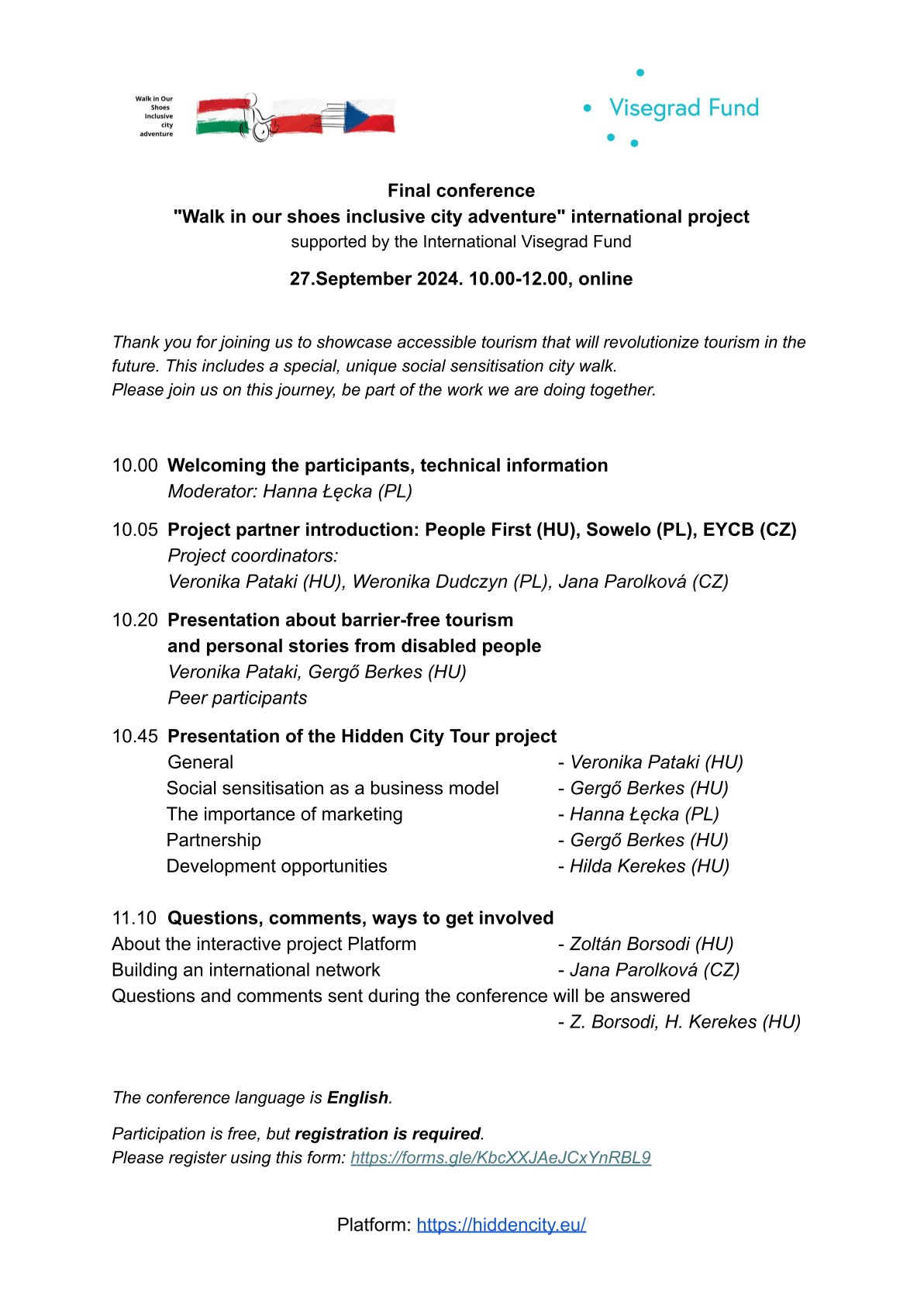
An exciting online conference will be held on 27. September from 10.00-12.00. The topic will be about the results so far of our Visegrad Fund supported project to deliver our Hidden City Tor-Tour project as a best practice.

You can find out what is accessible tourism, why is it so important for the near future.
Of course, we will talk about our unique social-sensitizing city walk, which is a novelty in tourism and a business opportunity.
You can hear from disabled travelers about their own experiences.
And you will also hear about how you can get involved in this segment of tourism with us.
Of course you can ask questions, comment, we will answer everything.

Our conference is free, but registration is required. Please register using this simple form: https://forms.gle/HqiaqwkNgEij9rza9

Invite your acquaintances too, because we are presenting a really unique topic and project. We are looking forward to the participation of tourism professionals, local government workers, representatives of disabled people’s organizations and anyone else who is interested in the topic.

Let us show you the Conference Program, we are sure you will like it:

CONFERENCE PROGRAM.docx

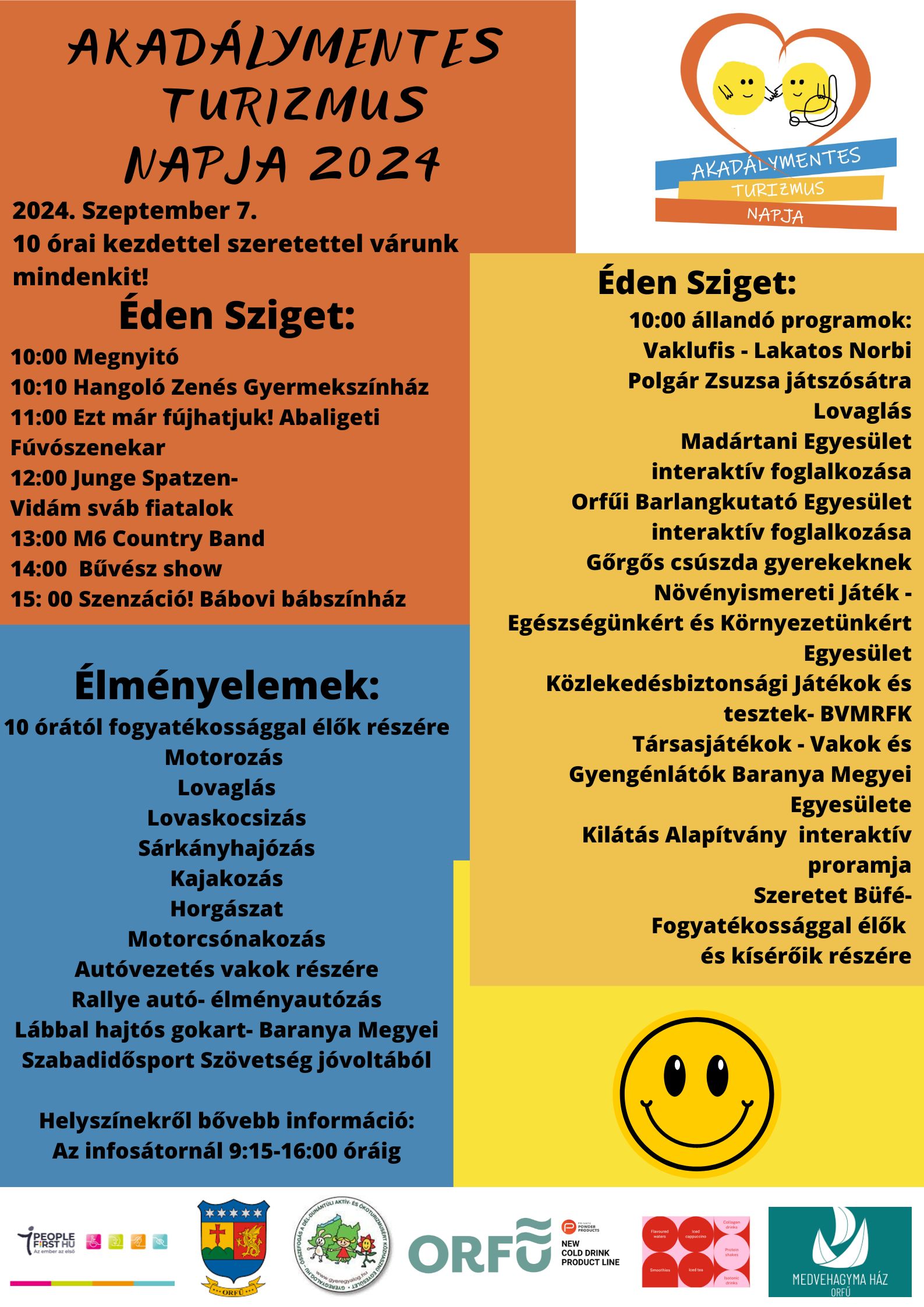
On 7. September Barrier-free Tourism Day in Orfű

Already for the 8th time we are organising the Barrier-free Tourism Day festival with our partners.
The cheerful event aims to promote inclusion, getting to know each other as disabled and able-bodied people, while spending a great day together in beautiful surroundings. Our fellow disabled people can have life-changing experiences that they wouldn’t otherwise have.

Read more about the event by clicking here: https://akadalymentesnap.hu/?lang=en

Let’s meet on 7. September in Orfű at “Nagytó” (Pécsi-tó), and have good encounters with each other!

The programme poster can also be read with a description for visually impaired followers here: https://akadalymentesnap.hu/2024/09/01/programme-poster-2024/?lang=en

Last Hidden City study tour in Czech Republic

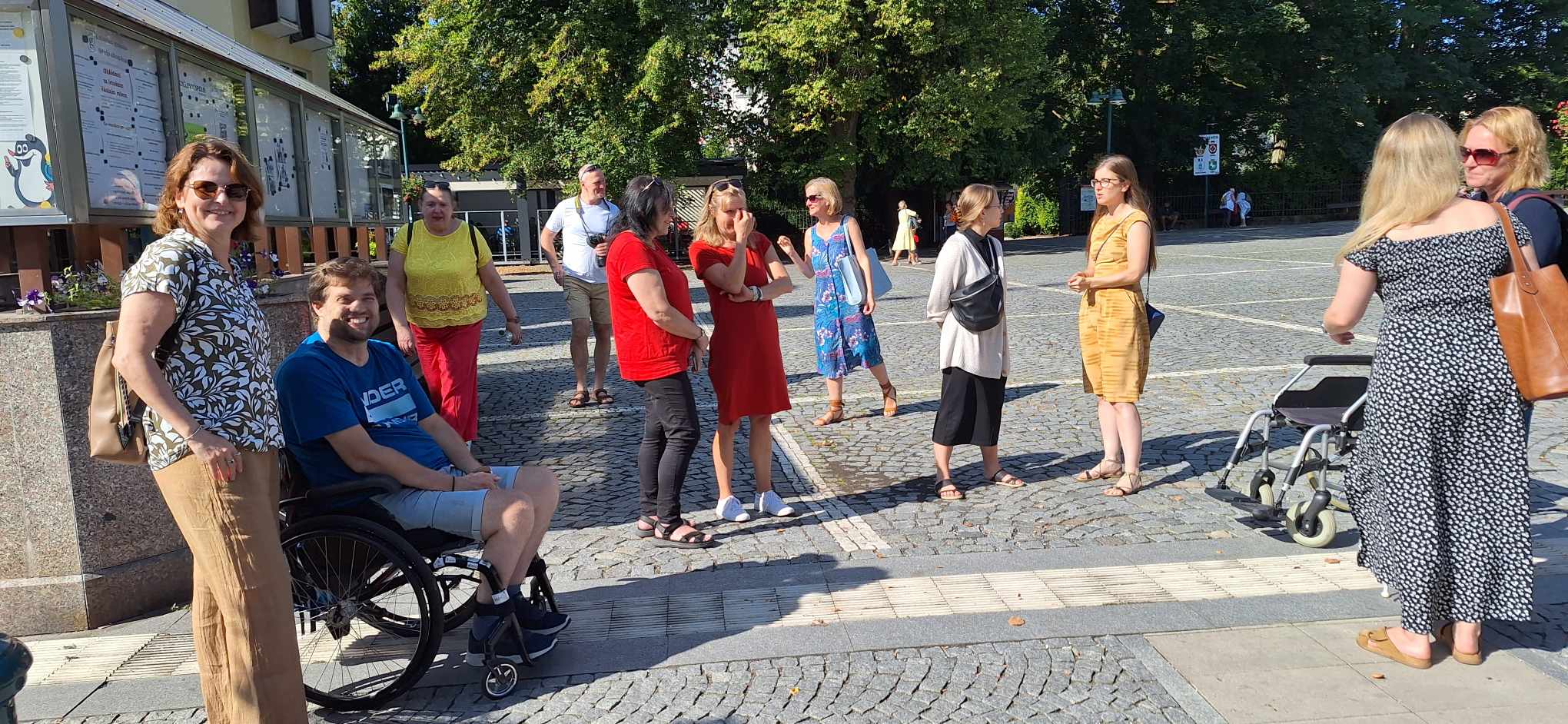
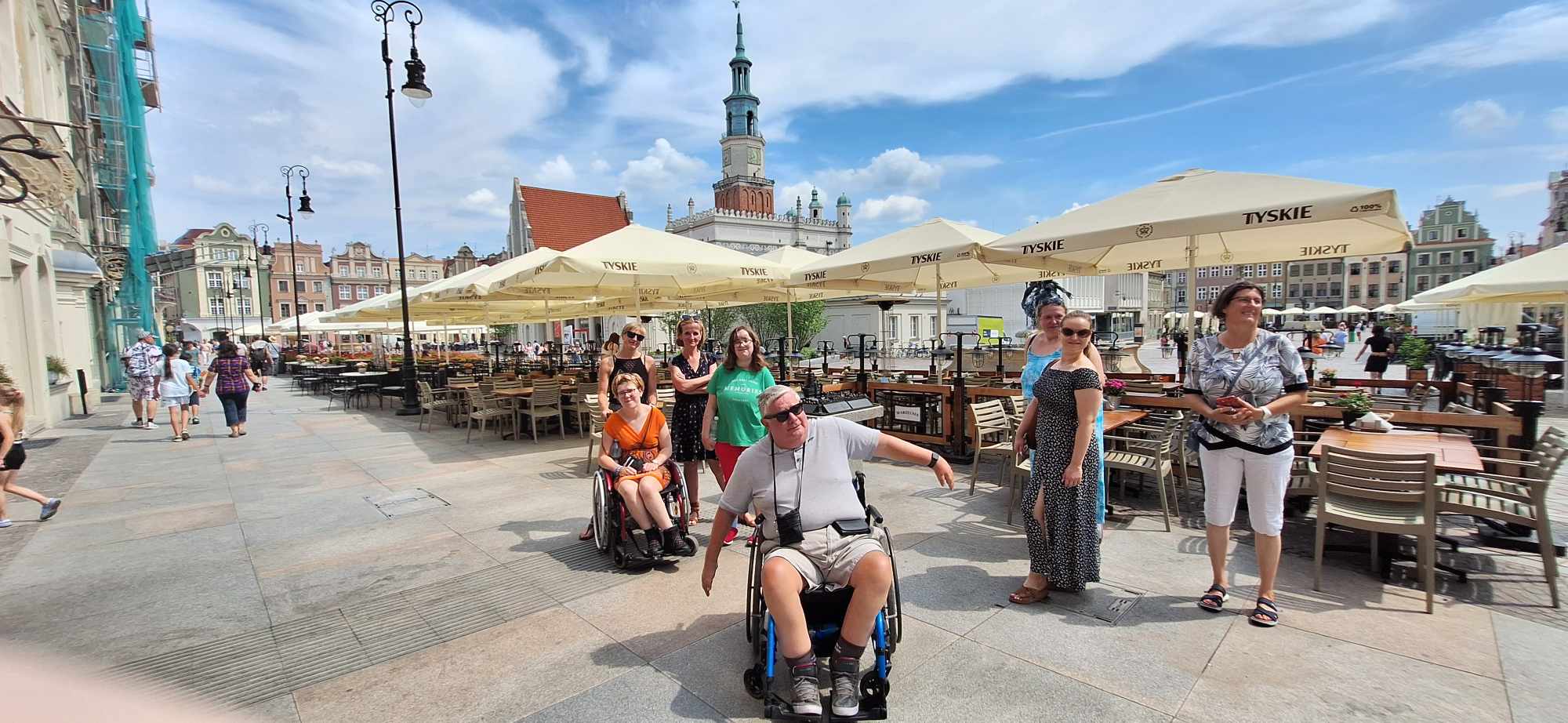
Our Hidden City Tor Tour project showcasing as a best practice, supported by the International Visegrad Fund, has reached an important stage. Using the professional material of the Hidden City Tor-Tour, invented and developed by the People First Public Benefit Association, we provided online training to our Polish and Czech partners. They then developed their own versions, which we visited in study tours to learn from each other. The first professional presentation took place in Pécs/Hungary, then we visited the Polish version in Poznan, and now we saw the Czech version of the Hidden City in Vrchlabi/Czech Republic, on 19-21 August.

A fantastic experience to watch three different cities, as three completely different approaches to the Hidden City sensitizing downtown walks are implemented. You may already know the Hungarian version, we hope many of you have already participated in one. If you haven’t yet, contact us, we are the best offer for corporate team building, school activities or an unconventional walk in Pécs with your friends! You can contact us here: info@peoplefirst.hu

Poznań is a much bigger city than Pécs, it would be difficult to do a circle walk of the city centre with a Hidden City Tor Tour, you have to choose your route carefully. However, that is why it is worth offering several route options here. There are accessibility challenges in this beautiful and touristically popular city, so it is worth involving the city administration and working together on these in the near future.

Vrchlabi is a small mountain town in a unique geological setting, which is definitely worth incorporating into a Hidden City project. You could even organise a special variation of accessible tours, as the local national park management seems to be interested. The small town offers a new experience with new features, and there is plenty more to bring to the attention of decision-makers and the public.

The next important step in our joint V4 project “Walk in our shoes” will be a final conference in the near future, where we will talk about the importance of accessible tourism, present the results of the project and broaden the partnership, which we welcome all those who wish to join through our interactive Platform. If you would like to participate in the online small conference to close the project and you speak English, you can already let us know, we look forward to welcoming you: info@peoplefirst.hu.

Follow us and join us in developing accessible tourism!

First newsletter of our CODE project

Important first steps have been taken in one of our very exciting international projects. This particular project will certainly be of great help to people with disabilities.

Our CODE project aims to make the banking sector and financial services more accessible. The aim of this unusually broad international partnership is to achieve social inclusion in this sector, and to increase the involvement of people with disabilities in this area.

You can read very briefly about this in the attached first newsletter.
Please also take seriously the call sentences at the end:
-follow us,
-share your own ideas and questions on the subject,
-and let’s make a difference together! 🙂

A CODE projekt első hírlevelét ide kattintva olvashatjátok:
Def_CODE_Newsletter1_July24

You can read a bit more about the CODE project here in the Projects menu of our website: CODE Erasmus+ international project – People First

The “Hidden City” went to Poznan!

In the framework of our “Walk in our shoes” project, supported by the International Visegrad Fund , we are sharing our Hidden City Tor-Tours, developed and run by the People First Association for several years, with our Czech and Polish partners as a best practice. We wrote training material and held an online training, then our partners developed their own methodology and now we can already see the results.

Between 15-17 July 2024, our partner  Fundacja Sowelo in Poznan showed us what a great Polish Hidden City tour they have developed. We really liked the organisation, the city was beautiful, the guided tour by a visually impaired guide was enjoyable.
Unfortunately, the city itself gave us some difficulties with wheelchairs at times, but it is another challenge and also opportunity for local NGOs to work together for accessibility.

After the Hidden City tour in Poznan, we held a professional meeting to evaluate the tour and make suggestions for its improvement. We planned the next study tour in the Czech Republic with our partner European Youth Centre Břeclav . This time, we will again enjoy a Hidden City tour in a completely different city with different characteristics in Vrchlabi between 19-21 August 2024. We can’t wait to experience the Czech version!

On the third day of the study tour, we visited the Brama Poznania museum as part of the Poznan accessible tourism. We recommend this interactive museum to anyone visiting Poznan. Not only is it very enjoyable, but it is completely barrier-free, with everyone in mind.

This is an exciting and great project, it’s a pleasure to pass on something that is working better and better in Pécs. The Hidden City Tor-Tour is a special, excellent form of social sensitisation. Our aim is not just to talk about the importance of accessibility, but to show it.

Read more about our “Walk in our shoes” project here: “Walk in Our Shoes”, international V4 project – People First

If you would like to take part in the closing online small-conference on 20. September 2024 and you speak English, you can let us know now and we look forward to welcoming you (info@peoplefirst.hu).

You can read about and even order People First’s Hidden City Tor Tour here. It’s a great idea for team building, school activities, or as a special Pécs city tour for friends: Hidden city Tor-Tour – People First

Scroll through the pictures on our Facebook page, it’s well worth it!


Indeed project meeting in Zilina/Slovakia

It is a great and motivating feeling when a professional meeting is not only useful but also pleasant!
At another face-to-face meeting of our Indeed international Erasmus+ project on independent living in Zilina, we learned a lot about the possibilities, achievements and planned developments of independent living in Slovakia, thanks to our partner Land of Harmony. The headquarters of the organisation is a building with two independent living apartments. Sitting in its pleasant garden, we got to know the organisation, its residents, staff and volunteers.

Later, we had a very interesting visit to the town hall, where we were welcomed by the mayor and deputy mayor, who emphasized that the exchange of experiences with other countries in the field of accessibility is very useful for them. A special team is working on accessibility, bringing together architects, social and transport experts. From an architect’s point of view, the aim is to link history and the future, with accessibility as one of the main tasks. It is important that accessible spaces and public buildings are not designed specifically for people with disabilities, but inclusively, i.e. for everyone together, involving the public and users. There are no specialised rehabilitation architects in Slovakia, where all architects are trained in universal design.
From a social point of view, it was surprising and gratifying to hear that in a city of 80,000 inhabitants, there are 36 municipally owned, rentable, accessible homes available. And they are all in use.
They also make an effort to take care of transport, although when we were there we often had problems with the pavements in wheelchairs and could not get into several buildings because of the stairs.

During a visit to the personal assistance agency, we saw that they do a lot of organising and work to help people with disabilities – with only two staff. Personal assistance in Slovakia is on the right track, but it has not yet fully achieved its goal. A legal regulation was achieved as a grassroots initiative in 1998. Taking into account several criteria (e.g. activity, number of children, social circumstances, availability of a job), it is possible to request the assistance of a personal assistant, which can amount to 20 hours per day per assistant. The support provided is varied: self-care, hygiene, mobility, feeding, shopping, housework, educational-, sporting-, and cultural activities, communication, nursing, organising leisure and holidays, transporting children to school, and stand-by care. There is also a database on clients and assistants, and on the needs, expectations and commitments of both. The exchange of experiences takes place on excursions and at joint cookouts, as there is no special club for assistants.
Unfortunately, personal assistant is not recognised as an independent job in Slovakia either. There is a contract between the disabled person and the assistant, a minimum social security contribution paid by the state and they also get tax relief for working more than a certain number of hours. But there is little income, and people become assistants mainly for personal motivation, so they usually take the job as a second/part-time job. The agency organises campaigns at universities, seminars and also works with the job center to offer this option as a temporary solution for the unemployed.

The New Synagogue, which operates as a cultural space, has become a great favourite of the international team. Here we heard a report about the inclusive festival Jasidielna (Jolly workshop). This colourful, cultural, international festival has been held in Zilina every year for 25 years. People with disabilities also perform as artists or volunteer at this festival. It was fascinating to hear the enthusiasm of volunteers who first got involved in the festival at the age of 15 or 17 and now, at 50, continue to support it as lawyers and NGO leaders. A festival like this is the best opportunity for young people in secondary school to gain direct experience of disability as volunteers.

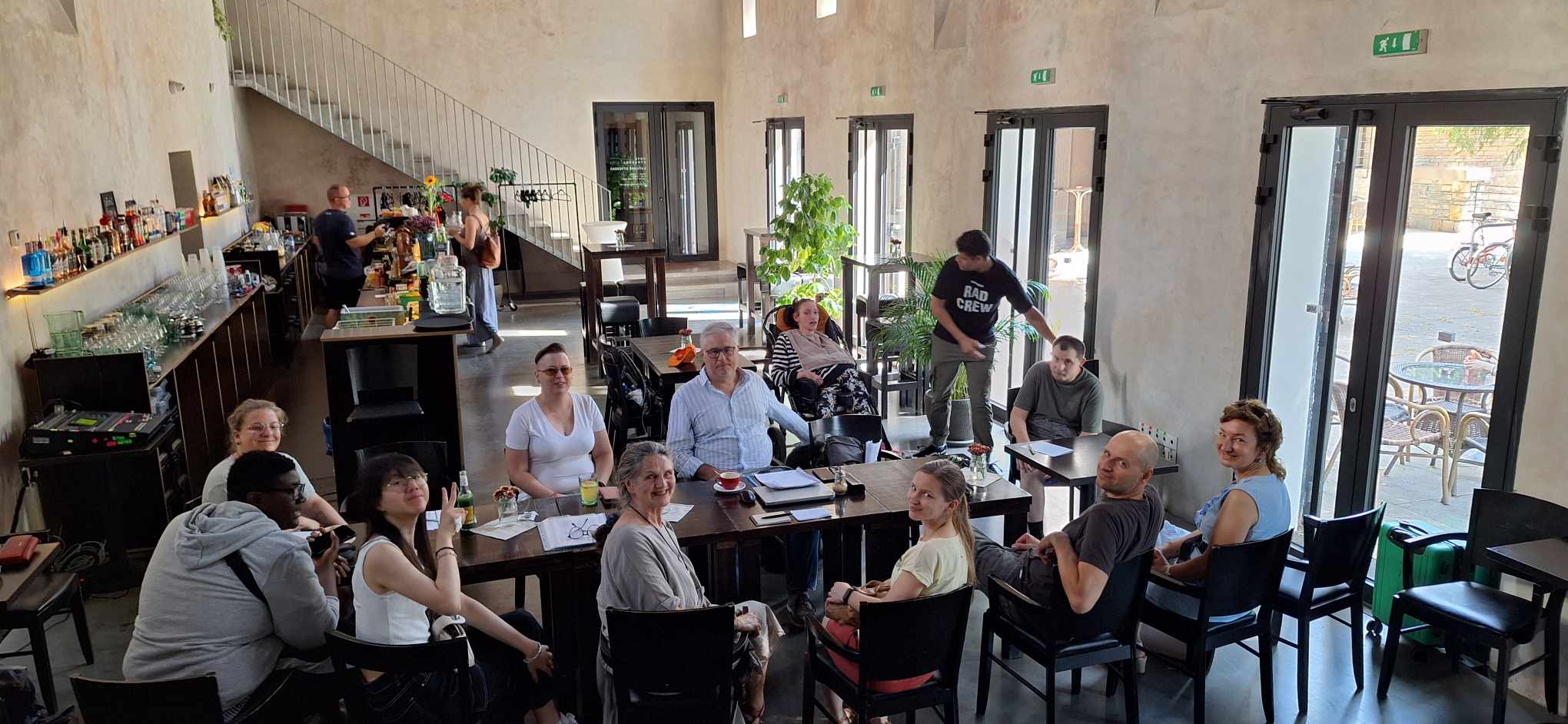
At the end of the two-day meeting, we returned to the garden to evaluate our experiences with Land of Harmony’s disabled volunteers. It was hard to say goodbye to beautiful Slovakia. Fortunately, we meet online every month, the work continues, and in October we will meet again in person, this time in Pécs/Hungary, hosted by the People First Public Benefit Association.

Read more about the Indeed project here: !ndeed Erasmus+ international project – People First

New steps towards accessibility in Pécs

We have received several requests to help make Pécs’ important sites accessible to all. It was a great experience to meet again with people who want to do something, to have useful discussions and to know for sure that we are moving towards a more accessible environment again. Which should not forget that it is GOOD FOR EVERYONE!

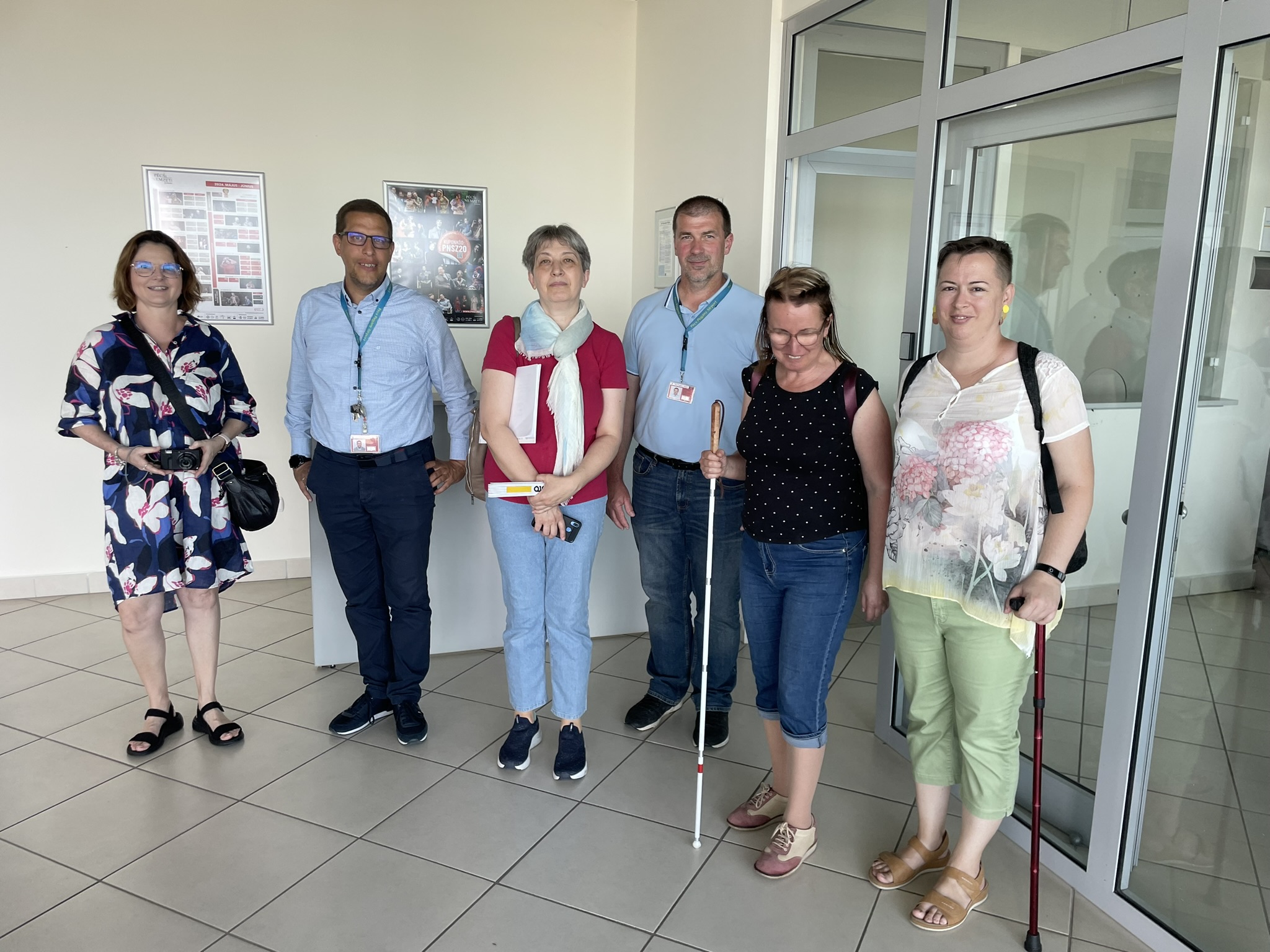
On the morning of 6. June 2024, we were met at the Pécs-Pogány Airport by Managing Director Márk Dragovácz, who has already indicated several times that he would like to make the airport even more accessible and inclusive for everyone. You can read the description of the airport in our Barrier-free Pécs Database (click here: https://peoplefirst.hu/en/directory/barrier-free-pecs/pecs-pogany-airport/)
This time, Ildikó Kakusziné Tamasy, a member of our association, a rehabilitation engineer, came from Szeged city to help us. We were delighted to be joined by Anna Mária Ballai, President of the Blind and Visually Impaired Association of Csongrád-Csanád County.
You can follow the accessibility changes in the Database!

The airport exploration, expected to be fruitful for both sides, was followed by an equally exciting meeting. Many people know that the Apollo Cinema in Pécs is not only a cinema, but also hosts very interesting community events in a nice and pleasant space. However, the art cinema, located on the first floor of a historical building, is not barrier-free. Gabi Varga, the manager of the cinema, wants to change that and make this great place accessible to all. We have worked hard on it, but here Ildiko has a difficult task.

Late in the afternoon we held the kick-off meeting of our Pécs City Civil Framework 2024 project. As a result of this project you will find 5 more accessible sites in our Barrier-free Pécs Database by the end of the year, thanks to the exploratory team: Evelin, Hilda, Krisztina, Gergő, Robi, Zoli responsible for the maintenance of the database, and the applicant/coordinator/data uploader Veronika.

Pécs City Civil Financial Framework 2024

Project title:
Pécs Városi Civil Keret 2024/Pécs City Civil Financial Framework 2024

Project duration:
01.06.2024.30.11.2024.

Supporter:
Local Government of Pécs

Project summary:
We will continue what we started last year. With the support of the City of Pécs, we will add 5 more truly accessible sites in Pécs and around Pécs to our Accessible Pécs Database.
The database has set an example for the city of Pécs. Its maintenance should be part of the city’s marketing, as its tourism marketing power is significant. There are only few areas of social problems that can connect so many target groups as accessibility.
Accessible places and programmes are a basic need for people with disabilities, and equally important for elderly people and parents with prams. But the temporarily disabled, and people with suitcases or shopping bags, also a great help. And EVERYONE is more comfortable in a barrier-free environment!

There is no list or map of accessible locations in Hungary. For people with disabilities, however, predictability is essential.
Therefore, in 2018, our association was the only one in the country to create a free Pécs city database of accessible locations in and around Pécs. In recent years, we have developed this from small grants, mostly from our own resources, into a professional one.
The aim is to provide urban populations with detailed and reliable information on accessible locations. Information is available in 12 categories, free of charge, in Hungarian and English, illustrated with many own photos, map display and contact information.
It also aims to develop barrier-free tourism in Hungary, to attract and inform tourists visiting Pécs (this is why it is also available in English). Since then, there has been no similar urban barrier-free database in the country.
The Barrier-free Pécs Database is available free of charge on our website in Hungarian and English: https://peoplefirst.hu/en/barrier-free-pecs/

Goal:
Training for the professional team of disabled people exploring the sites of the Barrier-free Pécs Database.
Exploration of 5 additional sites in Pécs and around Pécs during the project period.
Work is ongoing to strengthen existing cooperation with the town hall and to expand partnership building with other organisations.
Based on our measurements and domestic and international feedback, the citizens of Pécs and visitors feel a serious need for the Barrier-free Pécs Database and are happy to use it. We have recently taken steps to make this even more so in the future. Experts have helped us to optimise the website and database for Search Engine Optimisation (SEO), i.e. to reach as many users as possible.
The social sensitization effect of the database is extremely important for both disabled and able-bodied society!  Therefore, the Barrier-free Pécs Database and the Hidden City Tor-Tour  are closely complementary activities.

Target groups:
Our basic target group is people with disabilities. We do not focus on one group, since the membership of our association is also made up of people with all types of disabilities.
Our wider target group is the entire urban population and visitors. And EVERYONE who needs accessibility or is more comfortable living without barriers.

How does the project work?
In June 2024, an exploration team will be set up with professionally qualified participants with disabilities. We will conduct a preparatory training and create a detailed schedule and task list.
Between June and October 2024, 5 completely new barrier-free sites will be explored and recorded in Hungarian and English in the database.We will work in teams of 3 people, with disabled, visually impaired and assisting association members, including a hearing impaired member as needed.
Meanwhile, the IT maintenance and repair of the database is ongoing.
In November 2024, we will evaluate the results of the project and prepare for future tasks and funding opportunities.

Results and impact of the project:
People with disabilities do this work, as they are the best experts in their field/problems. They receive continuous professional training in the project. For them, this is a significant social inclusion opportunity: new skills, useful activities, earning money, learning, inclusion, empowerment, community building.
More sites are added to the Barrier-free Pécs Database. This is a great contribution to making Pécs more attractive and to the development of accessible tourism in Hungary.

Project sustainability:
In cooperation with the city, our database is part of the https://pecs.hu/en/ website.
We would be glad if the city administration, the city companies, and the city residents would be proud that such an initiative exists in Pécs, and more and more people would use and recommend it.

WHY campaign 16: WHY disability terms should be constantly changed?

This Why? is a bit more for Hungarian speakers, as we are discussing Hungarian terms of disability. But it can also be exciting to follow the changes in Hungary as a foreigner. Is it just Hungarian or is it a general phenomenon? We look forward to your comments below.

I could ask the question “what shall I call you”, if I want to quote our great poet Petőfi.

First, a little about the naming conventions we currently use.
There are two terms we use for disability in Hungary today: perhaps the most accepted is person living with disability. Why? Because it expresses that I have a disability – in my case a visual impairment – that is not part of my personality, but that I live with.
The other most commonly used term is a disabled person, which is used in legislation, literature and official places.
I fully agree with those experts who take the view that the two terms most commonly used today should be used in conjunction with the words “person”.

Previously, the word disabled was used quite naturally. Opinions are very divided on whether this is offensive or not. What is certain is that nowadays the word is used by many people as a abusive word, and has unfortunately become a kind of slang.

In general, the term injured is often used, but I think it is appropriate when used in conjunction with the type of disability, such as mobility impaired, visually impaired, hearing impaired. In itself, ‘injured’ can strengthens a damaged consciousness. Or it may not indicate an existing disability, but a temporary injury following an accident. In this way, a bruise or cut is also an injury.

The starting point however, is the use of now socially unacceptable terms such as stupid, crazy, cripple or idiot. Indeed, in the 19th century, these were common everyday and technical terms!
Stupid was the word for dumb, and then the word was applied to the mentally handicapped, but not in a pejorative sense, simply as a term. The same goes for idiot, used for people who didn’t understand social rules because they had a lower level of intelligence. And cripple was a general term for the physically handicapped.
The first institution for the mentally handicapped opened its doors in 1875 in Hungary in  Rákospalota under the name of “The First Hungarian Institute for the Education and Care of the Stupid”.
And in the early 1800s, a “public madhouse” was founded, which, according to the custom of the time, excluded disabled people from society and locked them up in institutions.
Another noteworthy term from József Roboz is the “weakly able”, which he mentions as a title in the first textbook he wrote on the concept of differentiated education.

Disease or condition? The question is a very good one, because I think disability is a condition that is either congenital or acquired later, i.e. it has been around for a certain period of time. In fact, it is usually the result of a disease, which is why I think the word ‘condition’ is more appropriate for disability.

There are also many different names for the types of disability. Each type of disability can be divided into several subgroups in order to distinguish the degree of disability. But it’s very much up to the individual person with a disability to decide which one they feel is their own, or which one is offensive to them. For example, I belong to the blind subgroup of the visually impaired, but I prefer to be called visually impaired. It’s worth remembering that we don’t need to know how much a visually impaired person can or cannot see, or how disabled a disabled person is, whether they are in a wheelchair or use a cane. It is therefore easiest to use the generic terms for a particular group of disabilities, to avoid awkward situations.

Why are names important? The most important thing is to always be respectful and to always respect the human dignity of the person concerned when referring to people with disabilities. Not just in their presence.

And back to the basic question, why do we have to keep changing the terms?
The main reason I think is, that society is constantly picking up on the technical terms originally used for people with disabilities. And they start to use it in hurtful, pejorative terms – mostly by able-bodied people to each other. It’s especially common for young people to call each other ‘disabled’ if someone doesn’t understand something the first time, or simply to insult or belittle. The same change has happened to our words ‘stupid’, ‘lame’, ‘cripple’, ‘crazy’, etc.
And people with disabilities themselves, and the profession dealing with them, now have to come up with particularly complex, unremarkable and strange ways of putting a name to what was and is a simple, understandable name.
Isn’t that crazy too?? Instead of fleeing forward, we should be educating society in kindergarten, school, family and everywhere. So that they stop throwing around words about people with disabilities, their condition, when they want to insult someone.

Written by Evelin Almádi and Veronika Pataki, also based on Panna Kaszás’ university thesis
Study tour in Pécs on our Hidden City project

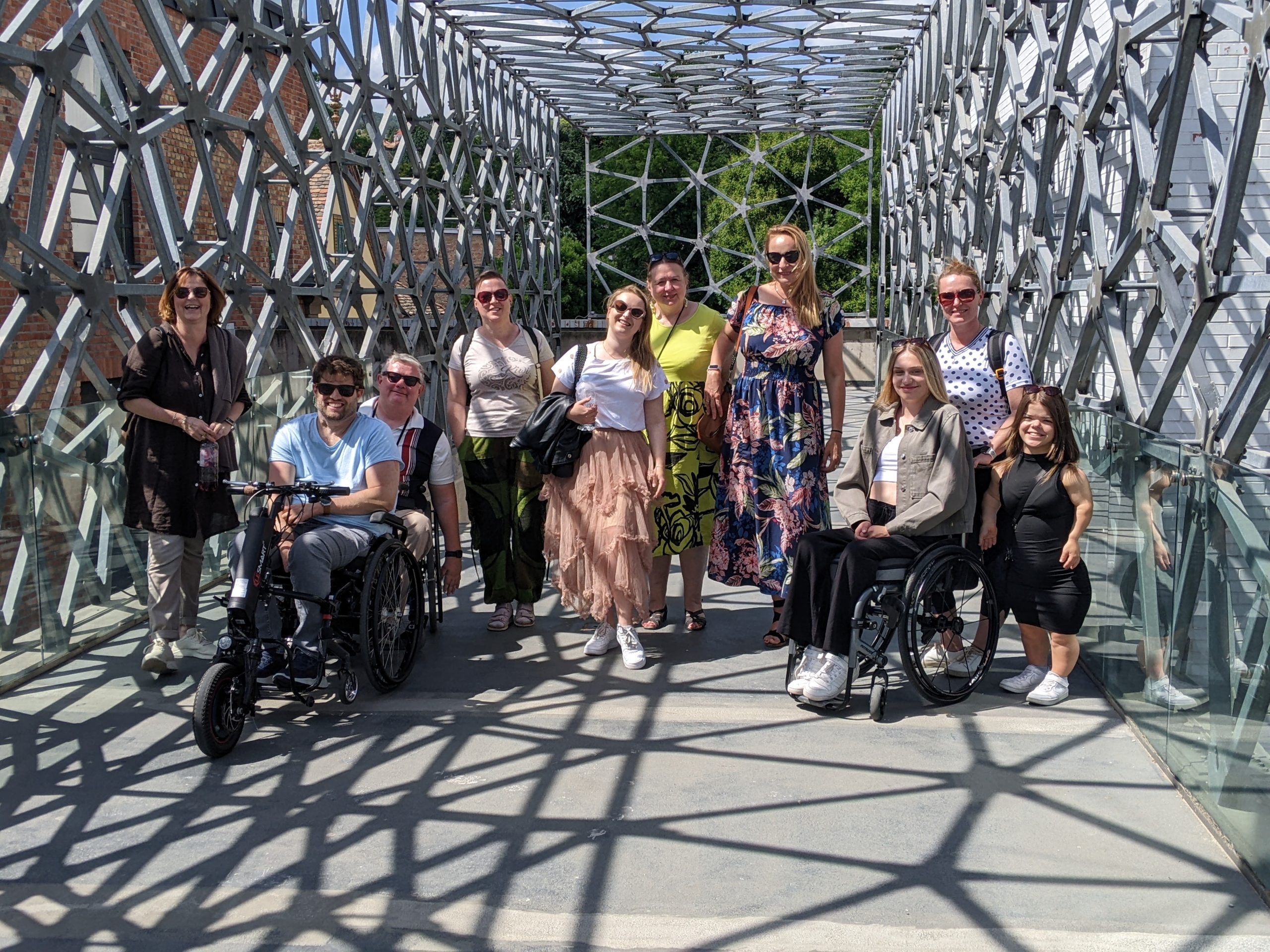
Our Polish and Czech partners visited us for a three-day study tour in Pécs. In the framework of our project “Walk in our shoes”, supported by the International Visegrad Fund, we presented our Hidden City Tor-Tour to our project partners as a best practice.

On a beautiful sunny morning of the meeting, Gergő Berkes the leader of the Hidden City Tor-Tour, and his support partner Zoltán Borsodi gave a walk through the city centre, from a barrier-free perspective. And that afternoon, in our BeFogadó community space we discussed the experiences so far, listened to the Polish and Czech project reports and planned future tasks. Even a tasting of Pécs wines and an accessible visit to Cella Septichora fitted into our programme. 🙂

The study tour was the first step to visiting each other. The People First Association had previously provided an online training to Fundacija Sowelo and EYCB members on how they could create similar sensitizing city-walks. Now they have been further helped by seeing us lead a Hidden City Tor-Tour live. Fortunately, we have enthusiastic partners who not only enjoyed the walk, but also gave us very useful opinions and suggestions for improvement!

In the current phase of the project, partners have developed their individual methodologies to organise their own Hidden City Walks.
We are looking forward to the next study tours in Poznan/Poland in June, and Vrchlabi/Czech Republic in August, to see what the Polish and Czech versions of the Hidden City look like!

Thank you for being here and we’re so glad you enjoyed our city!