Author Archives: Pataki Veronika

“Walk in Our Shoes”, international V4 project

The project’s communication platform is now ready! From now on, follow the project’s news and the best practices in accessible tourism from around the world there. Since it is an interactive platform, feel free to comment, discuss, connect, and build a community and joint projects together! Click here to access the platform: https://hiddencity.eu

Project title:
Walk in Our Shoes – Inclusive city adventure
Social Development, promoting an inclusive mindset in society and addressing protection and empowerment of minorities

Project period:
20.09.2023–10.02.2025 

Supporter:
The International Visegrad Fund: https://www.visegradfund.org/

Partner organisations:
People First Public Benefit Association, HUNGARY (https://peoplefirst.hu/en/)
European Youth Centre Břeclav z. s., CZECHIA (https://eycb.eu/en/)
SOWELO Foundation, POLAND  (https://sowelo.net.pl/


Project summary:
Spreading social sensitization in countries where democracy and human rights need to be strengthened. As a good practice, we share an innovative solution with our partners to spread the importance of accessibility.  

Accessibility and barrier-free tourism needs to be strongly promoted in the V4 countries (Czechia, Slovakia, Poland, Hungary). However, the receptivity is there in the V4 countries, the precedents are also there (accessibility efforts, laws, the society is receptive), so there is something to build on.
Lack of accessibility currently makes life difficult for many social groups. There is hardly a topic where the target group is so broad: not only disabled people are affected, but also the elderly, families with small children, people with temporary disabilities and everyone who wants to live more comfortably without barriers.
Accessibility is a problem at European level, but it is a definite deficiency in the former Eastern European countries (including V4). The kind of a playful, cheerful, self-experience-based form of social sensitization that our project offers as the best practice is much more effective. Society can benefit from being able to approach a social problem as an own experience. 
We want to create a network where we can share our experiences. We have a special, proven, good practice, and we would like to disseminate it within the framework of this project.. People First Public Benefit Association therefore offers our Hidden City TorTour as its best practice in this project.
https://peoplefirst.hu/en/blog-post/rejtett-varos-tor-tour-a/

In addition to the implementation in partner countries, we can also see what further development opportunities exist in our Hidden City project.  

Within accessibility, barrier-free tourism is also a major area to be developed in the V4 countries. Tourism operators have not realised that barrier-free tourism itself is an excellent business opportunity that they should take advantage of.  Therefore, another goal of the project is to promote and develop barrier-free tourism, also in an innovative and cheerful way. Our aim is not to put pressure on tourism actors (neither tourists nor tourism service providers), but to show the need and good side of accessibility. 

People can only understand the problem if they can feel it.
This means that we need to make people feel and understand that social inclusion is everyone’s business. Society is enriched with each active member. Accessibility is the core element of independent living.  

We noticed that people are happy to help. However, there is an inconceivable lack of information in society about accessibility and the needs of disadvantaged groups. Legislation and regulations on the need for accessibility mean a lot. But because they are mandatory, and because there is insufficient control over their enforcement, they are not fully implemented. 

There is no similar initiative in Hungary, this is a special, unique project. It is also completely unique in Poland and Czechia.  Participants of these Hiddes City Tor-Tour walks will most certainly be accessibility activists with a powerful multiplier effect!  

Important added elements of the project:
The walks are guided by people with disabilities, for them this is a job and learn opportunity!
Walks have to be paid for, so this is an income possibility for the NGO.
It is an excellent possibility to build professional relationships with tourist providers, with other local actors and participants. 

Target groups:
Residents of partner cities
Tourists from partner cities
Multipliers 

Goal:
The main goal is to provide our Hidden City Tor-Tour project within the framework of this project as the best practice that we would like to spread. 

How does the project work?
The People First Association develops training materials on the methodology of the Hidden City Tor-Tour. Than People First provides online training for partners on how to create their own Hidden City Tor-Tour in their country. It is up to the partnerswhether they adopt our method based on what they have learned in this project or add their own ideas too.
After the partners develop their own projects in Czechia and Poland, we proceed to piloting, i.e. we test them together. 

Sustainability of the project:
We will create a network with partners, which can be expanded to other countries later.  We organize an online closing conference on topics such as: barrier-free tourism, results and sustainability, building a wider network, involving new partners, new innovation opportunities, involvement of tourism professionals, publicity.

Follow the progress of the project here, or on the partners’ Web and Facebook pages.

Take a look at our Hidden City Tor-Tour with PécsTV:
Youtube People First

[blog grid=”1″ blog category=”51″]

What did we spend your support on in the Duplatét/Double Bet campaign?

At the end of last year, we received great help from you!
As part of our Duplatét campaign, we asked you to support our unique urban barrier-free database in Hungary. https://peoplefirst.hu/akadalymentes-pecs/ 

Thanks to the application of the Emberség Erejével Alapítvány/Power of Humanity Foundation, we were able to double the HUF 250,000 we received from you as a donation! We will be forever grateful to all our Hungarian and foreign supporters. 

We want you to know WHAT WE SPENT YOUR GENEROUS DONATION ON LAST YEAR: 

First, take a look at how many excavated locations we’ve been able to revisit and update.
This is an extremely important part of the Barrier-free Pécs Database, as an accessible database is useless if its information is not up-to-date! 

WE ASK YOU TO TAKE A LOOK AT THE LOCATIONS AND WRITE WHAT YOU HAVE EXPERIENCED IN THE DATABASE AS AN OPINION! We also welcome opinions in English and German.
You help a lot with this for other people with disabilities, people with strollers, the elderly, and everyone for whom accessibility is good.

The following locations have been updated and expanded with new information and photos: 

Laterum Hotel: https://peoplefirst.hu/directory/akadalymentes-pecs/laterum/   

Interspar: https://peoplefirst.hu/…/akadaly…/interspar-hipermarket/   

Széchenyi Square public toilet: https://peoplefirst.hu/…/akadalymentes-pecs/szechenyi-ter/   

Nana Bistro&Bar: https://peoplefirst.hu/directory/akadalymentes-pecs/nana/   

Pécs Plaza: https://peoplefirst.hu/directory/akadalymentes-pecs/plaza/   

Clinic downtown: https://peoplefirst.hu/…/akadalymente…/rendelointezet-2/   

Vásárcsarnok/Market Hall: https://peoplefirst.hu/…/akadalymentes-pecs/vasarcsarnok/   

Selyemgyár Kulturális Negyed: https://peoplefirst.hu/…/selyemgyar-kulturalis-negyed/   

Városháza/Town hall: https://peoplefirst.hu/dire…/akadalymentes-pecs/varoshaza/   

Magtár: https://peoplefirst.hu/directory/akadalymentes-pecs/magtar/ 

WE ARE LOOKING FORWARD TO HEARING YOUR OPINIONS ABOUT EACH SITE IN THE DATABASE! 

Another important piece of information is the accessibility of websites, especially since in Hungary this is mandatory by law.
An accessible website is especially important for visually impaired people, who without it will not be able to get any information about a location. 

We did not check the websites when the Barrier-free Pécs Database was launched, so now we have LOOKED AT EVERY SINGLE WEBSITE GOING BACK TO 2018 and included it in the descriptions!
We may still have one or two backlogs, but we will make up for it. 

It was a huge task, as was the CAPTIONING OF ALL IMAGES AND ILLUSTRATIONS on the website, which is also a great help for our blind and visually impaired site visitors. We captioned the images in three ways. 

We are happy to hear from stakeholders whether we are doing it properly. Thank you in advance, you will greatly help our work! 

If you consider it important and would like to support the database, you can do so by clicking on the Adományozok/Donate button on our website with any amount of money. You can even support our work continuously. 

Illusztrációs kép: középen egy laptop látható kinyitva, mellette egy íróasztal lámpa, egy csésze kávé, egy olvasószemüveg és néhány könyv. A laptop monitorján az Akadálymentes Pécs Adatbázis logoja, a matricával együtt, melyet az helyszínek ajtajaira ragasztunk. A felirat fölött a monitoron egy célkereszt, amibe épp egy nyíl talál bele. A kép fölső részén felirat: www.peoplefirst.hu

Barrier-free Tourism Day 2023

There will be the Barrier-free Tourism Day festival in Orfu again this year, even if the organization has been delayed.

The basic informations:

📌On September 2, between 10:00 and 16:00, we organize the VII. Barrier-free Tourism Day
📌Locations this year are only the Island and Medvehagyma House. The Sports Camp is only available for motorcycling.
📌Of course, there will be experiences! Namely:
sailing, motorboating
fishing
motorcycling
driving
horse riding, horse-drawn carriage rides
dragonboating

📌Organizers: Municipality of Orfu, Gyeregyalog.hu Association, People First Public Benefit Association – Pécs, Dragon Nest Foundation and Orfu Tourism Association

Details can be found continuously on the event’s Facebook page: https://www.facebook.com/turizmus.akadalymentes


New accessible feature on Google Maps, but….!

Google Maps stores information about the accessibility of more than 40 million locations worldwide, including public transportation, landmarks, and restaurants.
Based on this vast amount of information, this new feature can help people with reduced mobility plan their trips by checking if the location they are visiting has an accessible entrance. This can be useful for parents with strollers or travellers carrying suitcases.
But we emphasize, THIS APPLIES ONLY TO THE ENTRANCE!

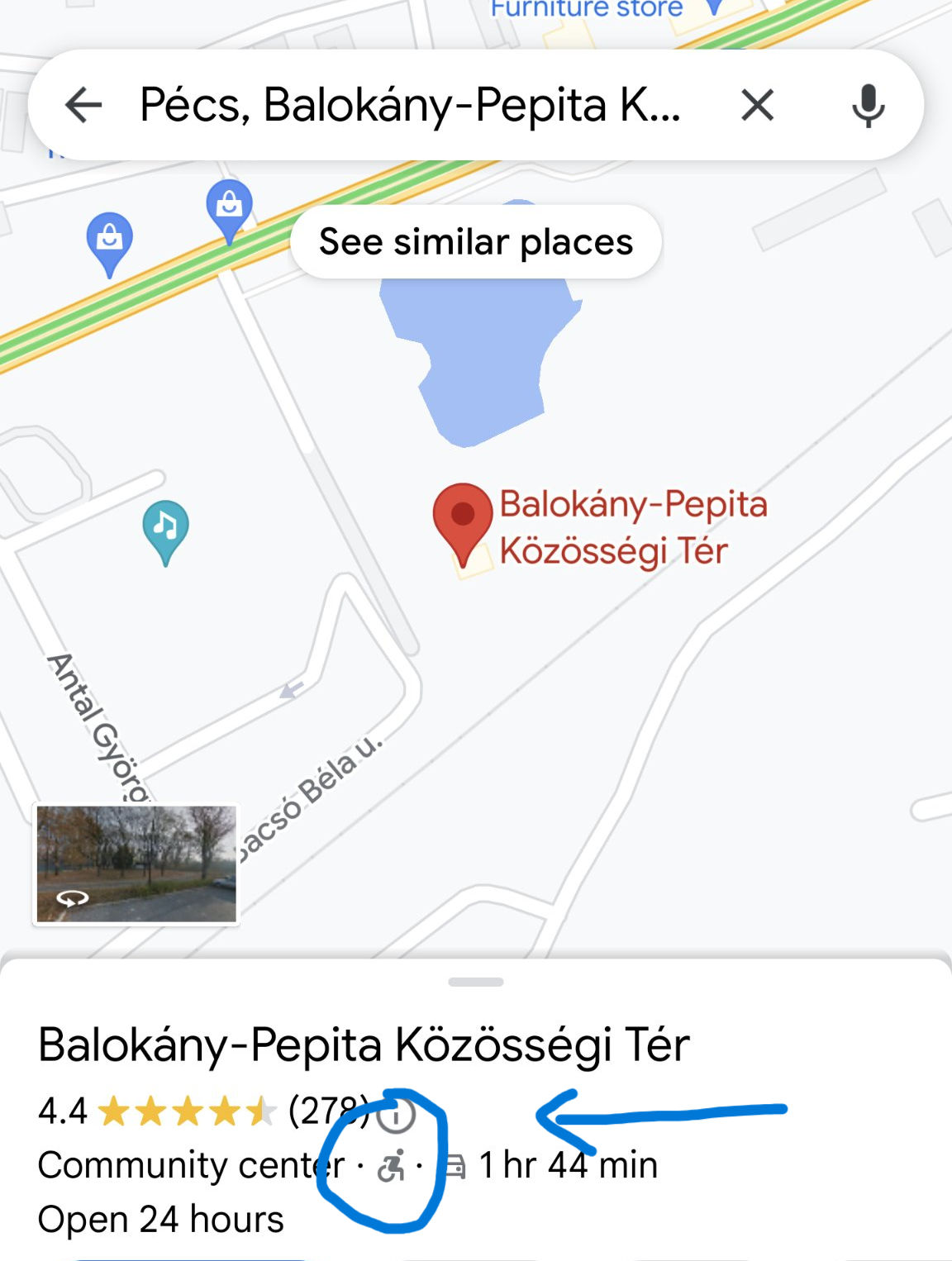
Google has made this new feature visible to everyone by default starting in May 2023 in the form of users seeing a wheelchair icon for places where there is an accessible entrance.
The same icon is crossed out where there is no accessible entrance or markup because no information has been received.

In this information Google relies on community contributions from local guide volunteers, businesses, and everyday users to make the feature work. Currently, information other than accessibility of entrances can only be filtered from individual reviews.

How can you get more useful accessibility information from specific locations?
The People First Association was the only one in Hungary to create a database that could be an even more useful tool than the new function of Google Maps for visitors to Pécs and its surroundings, as well as for locals.
In our Barrier-free Pécs database you can find truly accessible Pécs locations explored by the expert members of our association, with thorough descriptions and photos. The on-site inspection of our disabled and able-bodied members covers restaurants, cafes, hotels, tourist attractions, shops, cultural and sports objects, churches, public institutions, public toilets and tourist paths.
We show you not only the entrance, but also the use of the interiors, the approach, the usability of the website and much more. Explore our database in English here: https://peoplefirst.hu/en/helyszinek/

WHY campaign 14: WHY is boarding a bus in a wheelchair an extreme sport?

“I’ll catch a bus and I’m there” – but it’s almost never that easy. Especially if you bring your own chair or are a stroller driver.

So:
you catch a bus. You check the timetable, buy your ticket, go to the bus stop and hop on. If there’s a seat, you sit down, if not, you stand. Sometimes you’ll stand on my spot, which is fine if I don’t need it. You signal, you get off. On a crowded bus, of course, it’s all a bit more difficult.

I figure out where I want to go. I have to look for a stop I can get to with my wheelchair. I check the website/app to see when there’s an accessible bus on that line and hope that there really is one. Not always.

Oops: even when I ask the service provider in advance to send me an accessible bus at such-and-such a time, mistakes can happen: despite all the phone calls, e-mails and confirmations, the right vehicle does not arrive. Then all my plans fail. 

But now there is a good bus stop, the right kind of a bus just arrived, we are ready to go! The bus driver gets out, pushes down the ramp for me, helps me roll up if I need it. I maneuver myself to my place, put on the brakes, buckle myself in or the bus driver will help me. Ramp up, driver behind the wheel. When I get off, same thing in reverse. 

Nice plan, except there’s the ’oops’ factor: 

Oops! The bus is full and you’re in my spot. Then, if possible, the other passengers should move over. If not, or if the number of wheelchairs on that bus is already full, I’m stuck while others can still get on – and squeeze into my designated place as third. 
This can become an extreme adventure in the heat, rain and cold, because my body works differently! 

Oops! The bus driver is not well informed and refuses to let me on because he says my electric wheelchair is a scooter and you are not allowed to get on with a scooter. They might be not aware of my limitations and causing physical injury because they don’t know that I can’t feel, move my legs or hands or have difficulty moving them. 

Oops! My fellow passenger is not paying attention and they cause me injury or damage to my wheelchair. The wheelchair that allows me to get around. Which is not easy or cheap to fix. When was the last time you got stuck between four walls because someone stepped on your foot? 

There are many standing places and seats on a bus, but spots for wheelchairs, if any, are limited to one, rarely two. I can’t move back or in, stand and hold on, while for able-bodied people it’s much easier and it’s easier to move suitcases, trolleys, saplings from the place reserved for me than to put me on the hat rack! 

Much the same applies to prams, the pram is also the safe seat for the small passenger, with its own brakes and seat belt, and staff who, although get on easier, sometimes they need help too! 

Then there are the walker users (a kind of rolling walking frame, with brakes, seat, sometimes a basket), who can’t suddenly put the walker in their pockets or travel standing up and holding on to the handrails. Sometimes they also strap themselves into the wheelchair spot if they have no better option. 

We, wheelies: wheelchair users, walker users, pram drivers, ask you to take care when we come along and help us to get on and off the bus as easily, safely and quickly as possible, to take our seats – so that there are no more “oops”-es!

Written by Hilda Kerekes

Another way to solve your own problems

We highly recommend to your attention another opportunity that has just started to take the problems affecting you into your own hands. It can even be used in accessibility announcements!

A civil initiative that has been successfully operating nationwide for a long time has also become available in Pécs.
THE PÉCS JÁRÓKELŐ (PASSERBY) HAS STARTED.
Find and report a problem!

Volunteer case managers in Pécs connect city residents with the municipality and public utility providers to solve troublesome problems in public spaces.

tHE jarokelo.hu is a solution-oriented and transparent citizen customer service that aims to enable anyone to contribute to the quality of our environment with their reports, making our homes cleaner, tidy, safer and more beautiful.

The service has been operating since 2012 and solves about 6,000 cases a year. The Power of Humanity Foundation and Járókelő operate the Pécs interface in partnership. The popularity of this public space fault reporting page for city dwellers lies in its simplicity.

Read more about all this here:https://www.emberseg.hu/…/elindult-a-pecsi-jarokelo…/
and on the Járókő page, you can even immediately report a case:https://jarokelo.hu/

How accessible is your holiday?

Just starting out?
Or postpone it until a little later?
Are you vacationing nearby here or traveling far?🛸

☝️Please TELL US HOW ACCESSIBLE YOUR HOLIDAY WAS?

We will post it on the Facebook page of our association, let many people know where it is worthwhile, where it can be and where it is better not to go on an ACCESSIBLE HOLIDAY!

Send a short (but really) report✍️ and some pictures.📸
📧Here we are waiting for holiday experience reports (also in English):
info@peoplefirst.hu

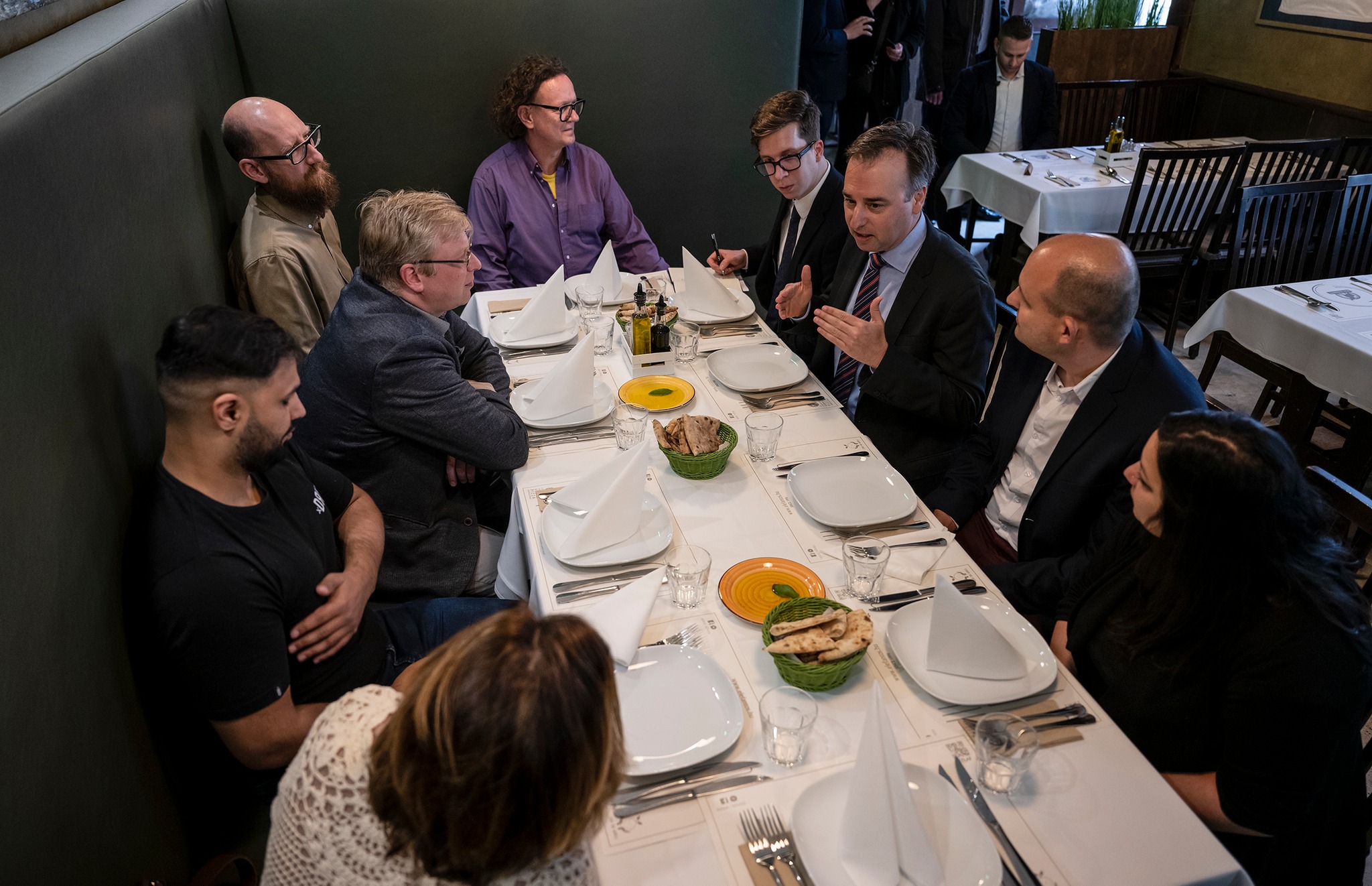
We had lunch with the U.S. Ambassador

It was a huge honor for our association on 17. April 2023.
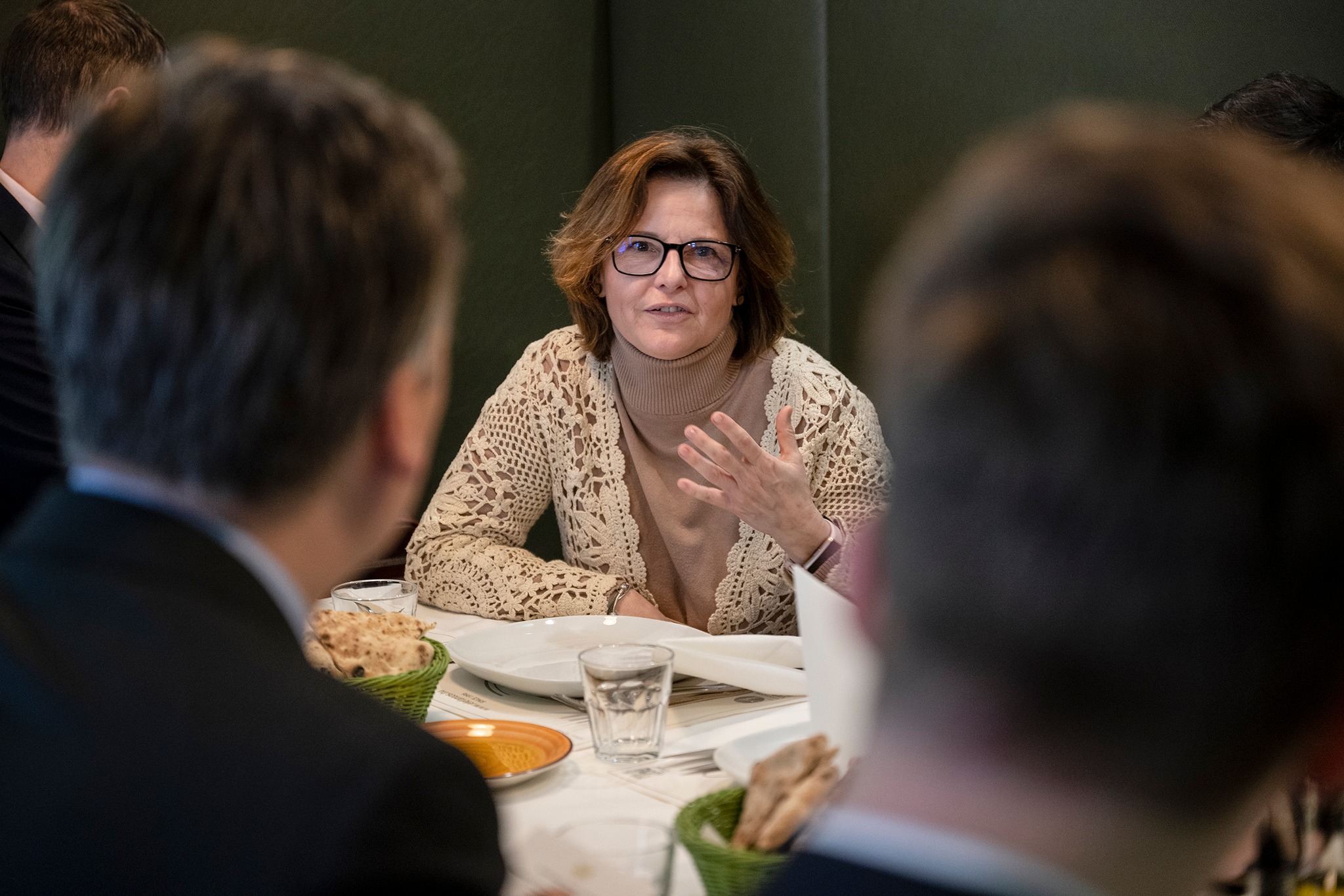
U.S. Ambassador David Pressman also met with NGOs during his visit to Pécs. During the working lunch, the People First Association also had the opportunity to introduce themselves and briefly exchange views with the Ambassador about the possibilities of civic life.

We are very pleased that, after the Dutch Ambassador, the American Ambassador also visited Pécs to get to know the point of view of Hungarians living in Baranya. Mr. David Pressman has expressed his commitment to continue to travel extensively around the country in order to meet as many opinions as possible.

As the Ambassador said: “It was wonderful to spend time with a diverse array of local community organizations working hard to ensure Hungarians from all walks of life have access to opportunities.”

More information about the visit can be found here: David Pressman’s visit to Baranya

Already 85 locations in our barrier-free database!

Since 2018, our association has been tirelessly exploring the truly barrier-free locations of Pécs and its immediate surroundings. We describe what we saw about the locations grouped into 12 categories, illustrate them with many photos, show them on a map where exactly they are located, provide contact details to get more information. All this in both Hungarian and English.

We have now introduced 85 locations to make it easier to find accessible venues for residents and visitors.

Our team works on the basis of methodology, continuously strengthened by professional trainings.

You can find all information about the database here on our website under the Barrier-free Pécs menu.

The Accessible Pécs Database is made available free of charge to those looking for accessible venues. It is also free of charge for each site to explore. However, all this, of course, costs us money. Thank you if you support our niche work, even through the ADOMÁNYOZOK (DONATE) button on our website, with as much as amount of money you want. ❤️

The most cheerful conference!

We closed our ARTcoWORKers international project with a very fun, very interactive conference on March 30, 2023!
In the People First Association’s “InnClusive” Community Space 70 guests were curious about the closing event on the relationship between art and disability.
Thank you for being with us!

The final international conference was preceded by a five-day evaluation training discussing the future in InnClusive. German, Dutch, Macedonian and Hungarian artists, people with disabilities, and artists with disabilities were engaged in conversation, sewing teddy bears, making shadow plays, brainstorming, looking at the city, and eating a lot (because that’s Hungary!), while a great team was formed.

Let’s keep in touch with artists and people with disabilities after the project on the ARTcoWORKers Facebook page, in the Facebook group and on the communication Platform that will be created soon!