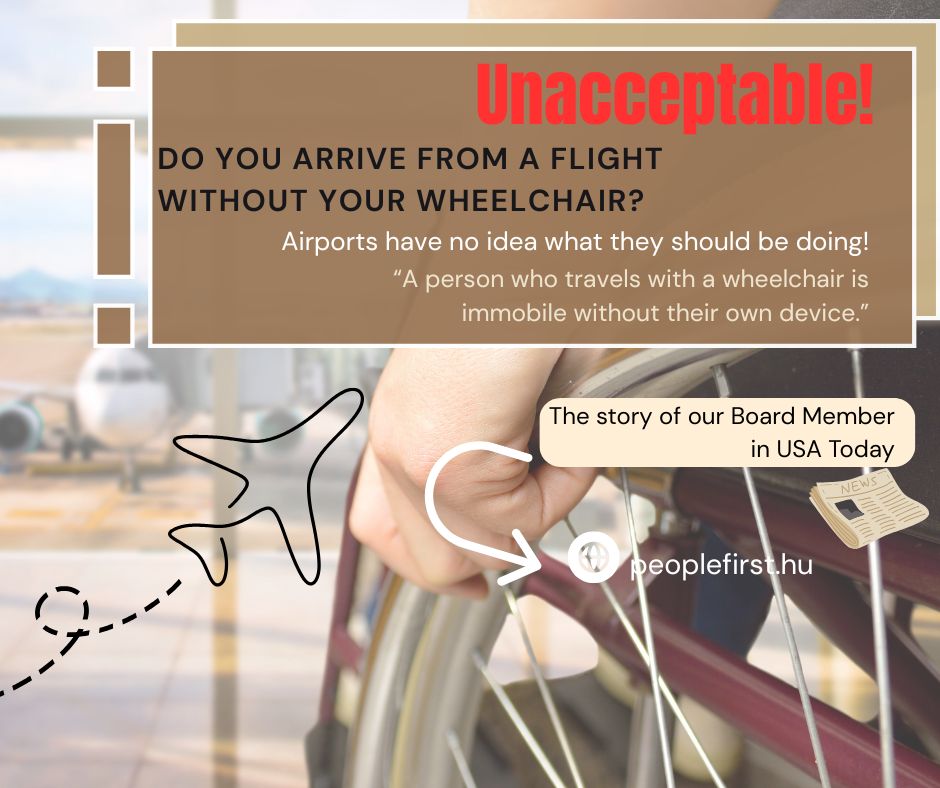
Our Association’s Board Member, Zoli Borsodi is a frequent traveler, and alongside all its advantages he also experiences all its disadvantages as a wheelchair user. After countless shocking incidents, the most recent one was the last straw for him, and he told his story as a lesson in the long-established American national daily newspaper USA Today.
Zoli and his family spent Christmas in Hungary and in January traveled back to the USA, with multiple connections via Copenhagen and Boston to North Carolina. Already in Copenhagen it was suspicious to Zoli that his own wheelchair was not at the exit, but at that time he still assumed this had happened because of the tight connection. However, in Boston there was nothing for him to transfer into, his own wheelchair had truly been lost.
And here let us stop for a moment: why is it so important for a person with a mobility impairment to be able to use their own chair?
A random, temporary wheelchair is uncomfortable and unusable, since everyone’s equipment is adapted to their personal needs. Just look around, you hardly see two identical chairs, and even if they look the same at first glance, the configurations, cushions, and devices in them make each one completely unique.
In Boston, no emergency protocol and no proposed solution awaited Zoli for this situation, and they did not find the wheelchair either. Since this has already happened five times to our member, fortunately with the help of an Apple AirTag he himself could see that all the suitcases and the chair had been left behind in Copenhagen.
The insured chair, beyond being uncomfortable, was a type that has to be pushed by someone else (here we write about the difference between a wheelchair and a transport chair), so Zoltán completely lost his independence. The complete lack of preparedness, the absence of a protocol for such cases, and the insensitivity of the airport staff resulted in another shocking twist. In Boston they promised that they would notify Durham airport, the final destination, so that a suitable wheelchair would be waiting for him there. However, when after 21 hours of exhausting travel he arrived in North Carolina, the staff there knew nothing about the case.
The airline that made the biggest mistake reacted to the incident as follows — after being contacted by USA Today:
“SAS strives to make travel for wheelchair users as smooth as possible. In this case we did not meet our own service standards, and we will work on improving training. We have contacted Zoltán Borsodi to make amends for our mistakes.”
Unfortunately however, they were not the only ones at fault, as during the lengthy journey no one showed either preparedness or empathy, and the airports simply have no plan for what should happen in such cases!
And unfortunately, situations like this occur countless times!
Surely you have all come across shocking videos of mad baggage handlers throwing, hitting, and smashing luggage and wheelchairs. And this is reality!
Just in the USA alone in 2024, airlines transported 899,385 wheelchairs and scooters, of which 11,357 (1.26%) were damaged or lost during transport (source: USA Today, United States Department of Transportation). But these are only the reported data!
That is why it is very important that passengers with disabilities notify the airlines if a problem occurs.
In closing, Zoli told USA Today that he hopes airlines and airports will better train their employees and develop a standard procedure for when mobility devices are mishandled. “Very few times have I encountered staff who know what to do, and how. A person who travels with a wheelchair is immobile without their own device.”
The full English-language article can be read here in USA Today: ‘I couldn’t leave the house.’ A missing wheelchair left him stranded.
Have you had a similar case, or have you heard about one? Write to us, as we are also curious what solution you would suggest.
info@peoplefirst.hu